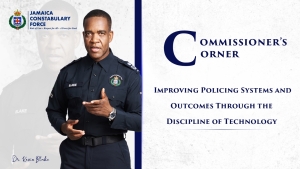
Modern policing is often described in terms of tools; systems, platforms, devices, and data. Yet tools do not define outcomes. Outcomes are shaped by how institutions think, how they act, and how consistently they apply discipline to the resources at their disposal. In his latest Commissioner’s Corner in the Force Orders, Police Commissioner Dr Kevin Blake advances a clear and necessary argument; that technology only delivers value when it is used deliberately, intelligently, and consistently by professionals who understand its purpose.
The Commissioner situates this discussion within a broader transformation agenda. He reminds members of the “People, Quality and Technology” programme, through which the Force has invested in governance, infrastructure, systems and cyber security. These investments have laid a strong foundation. They have equipped the Jamaica Constabulary Force with the technical capacity required to operate at the level of modern law enforcement agencies. Yet Dr Blake moves the conversation further still. Given that capacity alone is insufficient, the central question now becomes one of utilisation.
“The question before us now is how effectively we use the technology that we have to deliver better policing outcomes,” he writes. That question reframes the entire enterprise. Technology becomes a means rather than an end. It becomes an instrument of judgment.
The Commissioner is explicit in defining its purpose. “Every system we deploy… exists for one central purpose: to help us make better decisions, faster and with greater accountability.” This sentence establishes the intellectual core of the column. Policing is a decision-making profession. Technology strengthens that function by improving the quality, speed and traceability of those decisions.
He identifies the systems that now form part of the Force’s operational ecosystem: the Case Management System, the Station Records Management System, the Crime and Intelligence Management System, the Amber Connect Vehicle Monitoring System, and the Personnel Management System. These are not abstract tools. They are interconnected platforms designed to capture, organise and distribute information. Their collective value lies in integration.
For frontline officers, the implications are immediate. Technology provides “quicker access to reliable information that can guide… operations, support… intelligence efforts, help to steer… investigations, and generally enhance situational awareness.” Information, when timely and accurate, shapes action. It directs deployment. It sharpens focus. It reduces uncertainty.
For supervisors, the systems introduce visibility. They enable “improved oversight of cases, personnel and operational activities.” Oversight strengthens accountability. It ensures that strategy translates into execution. It allows leadership to intervene early when performance deviates from standard.
At the organisational level, the benefits extend further. Technology strengthens “transparency, improved record keeping, and better coordination across divisions and formations.” Coordination reduces duplication. Transparency builds trust. Record integrity supports both operational and legal processes.
The Commissioner summarises this succinctly: “Simply put, technology enables us to work smarter.”
Yet the column does not celebrate technology uncritically. Dr Blake introduces a crucial counterpoint. Systems do not operate themselves. “Technology, as powerful as it may be, does not solve problems on its own.” This statement anchors the argument in realism. The determinant of success lies in human behaviour.
He identifies mindset as the decisive factor. “We have to resist the urge of seeing these tools as additional administrative burdens, but instead embrace them as essential instruments of modern policing.” This shift in perception is foundational. When systems are treated as compliance exercises, their value diminishes. When they are treated as operational assets, they generate advantage.
The Commissioner traces the lifecycle of information within the organisation. “The information that you contribute at the end of your tour of duty… becomes a part of the intelligence picture down the road.” That intelligence, when “shared responsibly,” becomes “operational advantage.” Applied consistently, that advantage “creates safer communities.” This progression is precise. It connects individual discipline to collective outcome.
Training and compliance therefore assume central importance. “The investments we have made… must be matched by our collective commitment to use them properly.” Technology requires stewardship. It demands accuracy, timeliness and responsibility. Without these, systems degrade into repositories rather than engines of action.
The Commissioner also situates the JCF within a global context. “Leading police organizations are increasingly defined… by their ability to manage information effectively.” Information management now stands alongside courage and discipline as a defining characteristic of professional policing. This recognition places the Force within an international standard.
Importantly, Dr Blake affirms that Jamaica has already built a credible foundation. The work of the Technology Branch, the Telecommunications Division, and the Information and Communication Technology Division has “laid a solid foundation.” The infrastructure exists. The systems are operational. The opportunity is present.
The responsibility now rests with the members of the Force. “The true success of these systems will be determined by how well each of us integrates them into our daily work.” Integration transforms capability into outcome. It embeds technology within routine practice. It normalises data-driven policing.
Modern policing is built on information. Safer communities are built on how that information is used.