Preparing Policing for an Artificial Intelligence Future
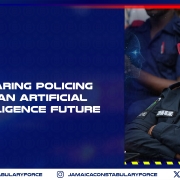
PREPARING POLICING FOR AN ARTIFICIAL INTELLIGENCE FUTURE
Artificial Intelligence (AI) is changing the way information is created, crimes are committed and evidence is assessed, prompting the Jamaica Constabulary Force (JCF) to examine how best to harness the technology as it prepares for the evolving demands of modern policing.
The issue came into sharp focus as the National Police College of Jamaica (NPCJ) hosted an AI Conference, bringing together law-enforcement personnel, members Jamaica Defence Force (JDF) and Department of Correctional Services (DCS), educators and students to examine the opportunities and challenges presented by the rapidly evolving technology.
Held under the theme “The Values, Benefits and Pitfalls of AI in an Integrated World,” the conference explored AI’s growing application in investigations, intelligence, national security and service delivery, while also examining questions of accountability, data protection and human judgement.
In his address, Assistant Commissioner of Police (ACP) Merrick Watson said the starting point for law enforcement should not simply be what AI can do, but what it should be permitted to do and who should make that decision.
“The more powerful AI becomes, the more important human responsibility becomes,” he noted, warning that “AI does not eliminate human errors, it can industrialise it.”
Watson said accountability must remain with people, particularly when AI-generated information is inaccurate.
That emphasis on human responsibility was also echoed by guest speaker Mr. Christopher Reckord, Chairman of Jamaica’s National Artificial Intelligence Task Force, who described AI as a “force multiplier” capable of helping officers process information and work more efficiently. However, he noted that “AI is here to assist us, not to decide for us,” adding that if police officers are going to use AI in their investigations, they must be properly trained, use approved tools and follow safeguards, particularly given the volume of personal and sensitive information handled by investigators.
At the same time, AI is changing not only how law enforcement can work, but also the environment in which officers operate.
Major Basil Jarrett, Director of Corporate Communications and Client Service Excellence at Major Organised Crime & Anti-Corruption Agency (MOCA), highlighted the growing challenge of determining what information is authentic as AI fuels the spread of misinformation, deepfakes and fabricated audio-visual content.
He said this has implications for law enforcement, particularly in investigations, evidence authentication and public trust, as criminals can use AI to impersonate officials and create convincing fake reports, voices and videos.
Jarrett also pointed to the growing use of AI in fraud and social-engineering schemes, noting that technology is allowing tasks that once took weeks to be completed in minutes. That evolving threat makes another skill increasingly important, the ability to question and critically assess information, even when it appears convincing.
Professor Paul Golding, Chairman of the NPCJ Appeals Committee and former Dean of the College of Business and Management at University of Technology, Jamaica (UTech, Ja.), said critical thinking must remain central to the use of AI.
“If critical thinking is not there, how do you criticise AI?” Golding said AI should work alongside people, with human beings maintaining oversight of both the technology and the information it generates.
The conversation extended beyond the speakers, with interactive panel discussions giving students an opportunity to engage directly with questions surrounding AI and its implications for policing, academics and society in general.
The discussions provided a glimpse into an emerging reality for law enforcement: AI is not simply a technology for the future. It is already influencing the information environment, investigations and the way criminals operate.
For the security sector, preparing for that reality means equipping officers to harness the benefits of AI while retaining the proper judgement to question its output, verify information and remain accountable for the decisions that matter.
JCF STRENGTHENS LEGAL COLLABORATION TO CONFRONT EMERGING CRIME AND SECURITY CHALLENGES

As crime becomes increasingly complex, technology-driven and interconnected, the Jamaica Constabulary Force (JCF) is strengthening collaboration among legal professionals across the national security sector to enhance the country’s collective response to emerging threats.
Through its Legal Affairs Division, the JCF hosted a conference on Thursday, September 24, at the Office of the Commissioner of Police under the theme, “At the Intersection of Law and Security: A Seminar for Attorneys-at-Law Operating in the National Security Sector.”
The initiative brought together attorneys from across Jamaica’s national security architecture to deepen professional relationships, share legal expertise and examine the increasingly important intersection of law, ethics and public service in the delivery of national security.
The conference comes against the backdrop of an evolving crime environment in which cybercrime, financial fraud, virtual assets, artificial intelligence and digital evidence are presenting new and increasingly complex legal considerations for law-enforcement and national security agencies.
While agencies must continuously adapt to new technologies and criminal methodologies, they must do so within a strong legal framework that protects constitutional rights, upholds due process and maintains the integrity and admissibility of evidence.
SSP Brown-Blake, head of the JCF’s Legal Affairs Division, said the conference was developed in recognition that many of the legal challenges confronting their attorneys are interconnected.
“Attorneys-at-Law across the national security sector face many related legal issues but have limited opportunities to exchange experiences and build professional relationships. With the guidance of the Commissioner of Police and the JCF Staff Officer, the conference was therefore created to foster greater collaboration and strengthen the legal response to shared national security challenges,” SSP Brown-Blake said.
Strong legal collaboration is equally important to helping agencies navigate complex investigations, emerging technologies and evolving threats while maintaining the rule of law.
SSP Brown-Blake said this is particularly important in an environment where crime increasingly cuts across institutional and jurisdictional boundaries.
“Crime and national security challenges are increasingly complex and interconnected, requiring agencies to work more closely together. As One Force for Good and Jamaica’s leading national security law-enforcement entity, the JCF believes in leading from the front by bringing partners together. I personally believe that effective collaboration depends not only on laws and formal protocols, but also on trust, professional relationships and the ability to engage respectfully even where institutional positions differ.”
The conference therefore placed deliberate emphasis not only on legal knowledge, but also on building the professional relationships and institutional trust needed to support effective inter-agency cooperation.
Presentations were delivered by King’s Counsel Caroline Hay; Judi-Ann Edwards, Senior Attorney-at-Law and former Deputy Director of Public Prosecutions; representatives of the JCF Medical Services Branch; and ASP Romario Reid.
Participating legal officers represented the Jamaica Constabulary Force, Jamaica Defence Force, Ministry of National Security, Department of Correctional Services, Major Organised Crime and Anti-Corruption Agency, Jamaica Customs Agency, Firearm Licensing Authority, Passport, Immigration and Citizenship Agency, and Police Civilian Oversight Authority.
Sponsored by the Pan American Development Foundation (PADF), the conference also explored the particular responsibilities of attorneys operating within government and national security environments. Discussions addressed the need to balance personal convictions with organisational objectives, manage the physical and psychological demands of high-pressure environments, and maintain professionalism and courtesy even in adversarial circumstances.
Beyond the exchange of legal knowledge, the initiative is intended to help develop a stronger network of national security attorneys who can draw on shared experience and trusted professional relationships when confronting complex legal issues.
For the JCF, that collaboration is part of a broader strategic imperative: ensuring that Jamaica’s response to increasingly sophisticated crime is operationally effective, legally sound, and constitutionally grounded.
Police Seek Witnesses For Court

POLICE SEEK WITNESSES FOR COURT
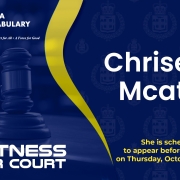
Detectives assigned to the St Ann Criminal Investigations Branch (CIB) are seeking the public’s assistance in locating two witnesses who are vital to a case currently before the St Ann Circuit Court. They are Deidranae Jeffery of Hyslope Avenue, Rockfort, Kingston 2, and Raisha Eccleston of Jacques Road, Mountain View, Kingston. They are scheduled to appear before the court on Thursday, September 24. Deidranae Jeffery, Raisha Eccleston or anyone knowing their whereabouts is asked to contact the Ocho Rios CIB at 876-974-2469, the police emergency 119 number, or the nearest police station.
Blake Warns Against Commentary Based on Misleading Headlines
BLAKE WARNS AGAINST COMMENTARY BASED ON MISLEADING HEADLINES
Commissioner of Police Dr Kevin Blake has urged members of the public to read articles in full before commenting on them, warning that misleading headlines and distorted interpretations can create messages that were never intended.
Writing in his latest Commissioner’s Corner column, published in the weekly Force Orders, Dr Blake said the feature was created to facilitate meaningful discussion among members of the Jamaica Constabulary Force but had increasingly become the subject of wider public commentary.
“The Corner is intended for us to have meaningful discourse among ourselves as members of the JCF. However, it has become the source of much public discourse. And we have no issue with that.”
The Commissioner said difficulties arise when commentary is based on headlines or partial accounts rather than the complete text.
“There are some spaces who make their own headlines, and skew much of what is said to create different messages,” he said.
Dr Blake advised external commentators to “avoid commenting on an article that you have not read”, adding: “Read, understand, then comment.”
He made clear that he was not objecting to criticism or public discussion of the column. The Commissioner said informed responses could provide useful perspectives for the organisation.
“If you do, we may very well benefit from good feedback and suggestions that we can use,” he said.
Dr Blake placed the issue within the wider context of social media, which he said had changed the speed and reach of public communication.
He acknowledged that digital platforms allow people to mobilise assistance, educate others, share information, expose wrongdoing and bring communities together.
However, he warned that the same platforms could be used to spread false or malicious information and manufacture controversy in pursuit of online engagement.
“There are those who have chosen to use these platforms not to inform but to misinform; not to build but to destroy; not to contribute meaningfully to public discourse but to manufacture controversy,” he said.
“Some seem to measure success by the number of likes, shares, views and followers they can accumulate, even when what they are circulating is false, malicious or deliberately misleading.”
The Commissioner also cautioned against treating popularity or wide circulation as evidence that information is accurate.
“The fact that something is circulating widely does not make it true,” he said. “The fact that someone has thousands of followers does not make them credible. And the fact that a story is sensational does not make it worthy of our attention.”
Dr Blake urged social-media users to exercise greater responsibility when publishing or circulating information.
“We should therefore exercise some maturity in what we post, what we repeat and what we share,” he said.
The Commissioner also told JCF members that they must remain receptive to legitimate criticism while refusing to become distracted by every rumour, provocative post or online controversy.
“We must see the environment in which we operate, understand the challenges we face, listen to legitimate criticism and remain alert to emerging threats and opportunities,” he said.
“But having seen all of that, we must still be able to keep our eyes on the destination.”
Dr Blake described this approach as “blinkered focus”, which he said required members to determine which issues deserved their attention while remaining guided by facts, the values of the organisation and its mission.
“Not everything that is said about us deserves a response,” he said. “Not every rumour deserves our attention. Not every social-media post deserves to become a matter of discussion in the workplace.”
He added: “Sometimes the most disciplined response is no response at all.”
Public Servants’ Private Lives Are Not Public Property — Blake
PUBLIC SERVANTS’ PRIVATE LIVES ARE NOT PUBLIC PROPERTY — BLAKE
Commissioner of Police Dr Kevin Blake says accepting the responsibilities of public service does not make every aspect of a person’s private life a matter for public consumption.
Writing in his latest Commissioner’s Corner column, published in the weekly Force Orders, Dr Blake acknowledged that police officers and other public servants must expect scrutiny of their official conduct.
“When we accept the responsibility of public service, we accept that our conduct in the execution of our duties will be subject to public scrutiny,” the Commissioner said. “That comes with the territory.”
He said the public has a legitimate interest in assessing how public servants perform their functions, exercise authority and uphold the standards required of them.
Dr Blake, however, argued that this legitimate interest does not extend automatically to every aspect of a person’s private affairs.
“Being a public servant does not mean that every aspect of your private life becomes public property,” he said.
The Commissioner described the boundary as the difference between “public accountability and public entitlement”.
“Our positions do not erase our right to a private life,” he said. “What happens within the legitimate boundaries of our personal lives is not automatically the business of strangers, social-media commentators or anyone who happens to have an opinion and an internet connection.”
Dr Blake said personal matters properly contained within an individual’s private life should remain under that person’s control.
“Our private lives belong to us, and to the friends and families with whom we choose to share them,” he said.
The Commissioner’s comments formed part of a wider discussion about the effects of social media on public discourse and the rapid circulation of information.
He acknowledged the value of digital platforms in educating the public, sharing information, mobilising assistance and exposing wrongdoing.
However, Dr Blake warned that social media could also be used to circulate false or malicious claims and manufacture controversy.
“There are those who have chosen to use these platforms not to inform but to misinform; not to build but to destroy; not to contribute meaningfully to public discourse but to manufacture controversy,” he said.
The Commissioner also cautioned that freedom of expression does not provide unlimited protection for false statements that damage another person’s reputation.
“Freedom of expression is important, but it does not give anyone an unlimited licence to make false and damaging statements about another person,” he said.
“There are legal consequences for defamatory and libellous statements because the law recognises that a person’s reputation is valuable and that when it is wrongfully damaged, the victim should have a means of seeking redress.”
Dr Blake urged social-media users to exercise greater care when creating or circulating content.
“We should therefore exercise some maturity in what we post, what we repeat and what we share,” he said.
He also warned against treating wide circulation or the size of a person’s online following as proof that information is accurate.
“The fact that something is circulating widely does not make it true.The fact that someone has thousands of followers does not make them credible.”
The Commissioner said a balance must be maintained in which public servants remain accountable for their official conduct while retaining the personal dignity and privacy afforded to other citizens.
“We must build a culture in which public servants are accountable for what they do in the discharge of their responsibilities, while still being afforded the dignity and privacy to which every human being is entitled,” Dr Blake said.