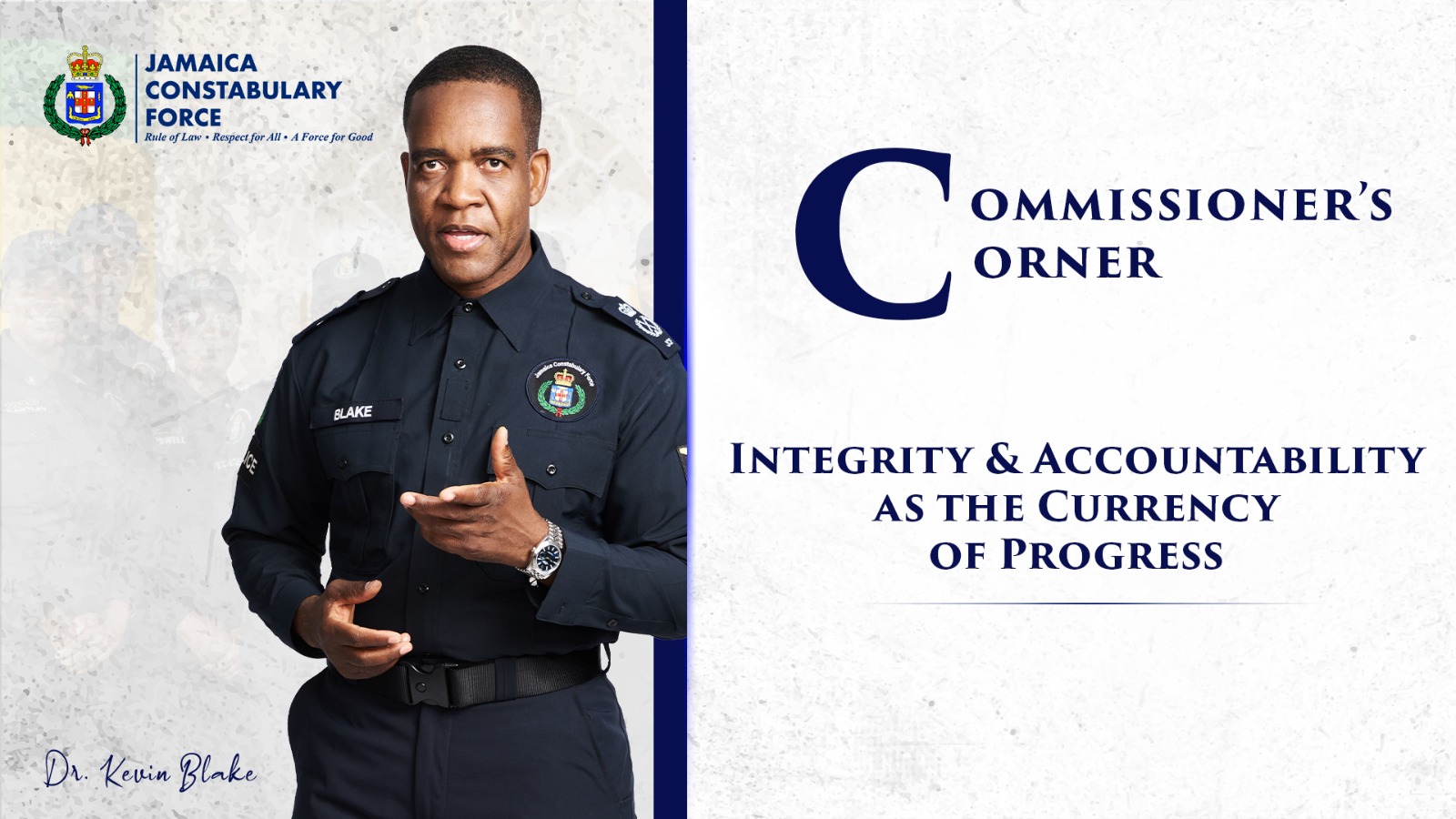
Integrity & Accountability as the Currency of Progress
There are moments in the life of a public institution when progress must be defended as carefully as it is pursued. In his latest column in the weekly Force Orders to the members of the Jamaica Constabulary Force, Police Commissioner Dr Kevin Blake confronts such a moment with clarity and restraint. He anchors his message in achievement, but he directs attention toward the conditions required to sustain it. The result is a meditation on resilience, credibility, and the discipline demanded when success and vulnerability coexist.
The Commissioner begins by acknowledging that January ended with 33 murders, which is a figure he notes is “the lowest number of murders in a month since we have been aggregating data by month in 2001.” He goes further, noting that it is “the lowest in more than 30 years,” surpassing even recent record-setting months. These numbers matter because they confirm that our strategies, efforts, and resolve are producing results. They also matter because they raise the stakes. Progress invites greater scrutiny; and rightly so. Progress tests institutions. Progress exposes weaknesses that can either be addressed or exploited.
Dr Blake does not treat crime reduction as a technical exercise divorced from public confidence. He links the two explicitly. “For us to do this, we have to continue to enjoy the trust and confidence of the people of Jamaica,” he writes, extending that obligation to partners and stakeholders “both local and international.” He describes reputation and integrity as assets that must be guarded “like a fortress.” In public sector leadership, trust functions as currency. It is accumulated slowly and spent quickly. It enables cooperation, legitimacy, and sustained performance.
The Commissioner’s most arresting contribution comes when he addresses the fragility of that trust. “Confidence and trust are fragile and fickle. They are difficult to earn and easy to lose.” He acknowledges that the organisation has been “hit by a few unfortunate events that threaten to erode the confidence of our stakeholders and those who we serve.” The language is measured, but the CP’s diagnosis is direct. Institutions are often weakened less by external attack than by internal failure.
Rather than dwell on the setback itself, Dr Blake shifts the frame to response. “These ‘own goal’ events have occurred and cannot be undone … now, it is about how we respond.” This is the pivot of the column. He rejects resignation. He rejects fatalism. He rejects the idea that a moment defines an institution’s identity. He asks whether the organisation will allow events to define who it is, or whether it will “get to work at rebuilding the trust of those on whom we depend to help see this mission through.”
Resilience, in this telling, becomes an operational discipline. It applies to confronting violent criminals, but it also applies inward. “Resilience… is also about maintaining our credibility and integrity, even while it is threatened from within,” he writes. This sentence carries institutional weight. It asserts that ethical fortitude matters as much as tactical success.
The Commissioner argues that healing requires renewal. Sometimes that renewal is uncomfortable. “We sometimes have to make sweeping changes to our structures, processes and systems … weaknesses that were exploited are addressed, and vulnerabilities removed.” He frames reform as a learning opportunity, a chance to “build back better.” This language echoes contemporary public management thinking, where organisations evolve through reflection, adaptation, and disciplined correction.
Notably, Dr Blake acknowledges the human cost of reform. “These changes… sometimes affect many who themselves are not culpable in any way,” he writes. He does not minimise that reality. He integrates it into a broader appeal for collective responsibility. Renewal is shared work. Every member is “a part of that renewal effort.” This approach avoids scapegoating while preserving accountability.
The Commissioner’s philosophy of credibility is uncompromising. “What we do from this point forward will matter more than anything we say. Credibility is restored quietly, through consistent conduct, difficult decisions, and the willingness to correct ourselves when necessary,” he notes.
Dr Blake reinforces the importance of individual responsibility within collective mission of the JCF. “Each of us has a role to play in that work, whether visible or unseen. The moment requires steadiness, restraint, and an uncompromising commitment to doing what is right, even when it is uncomfortable or inconvenient.”
In the final analysis, the Commissioner remains confident in his message to the members of the JCF “because of the professionalism and resolve” he sees across the organisation. He reminds members that the January results were earned, and that sustaining them “will demand the same discipline every single day.” Focus, mutual support, and mission clarity become the pathway forward. If those conditions hold, “the numbers will follow; and so will the trust we are determined to protect and restore.”