
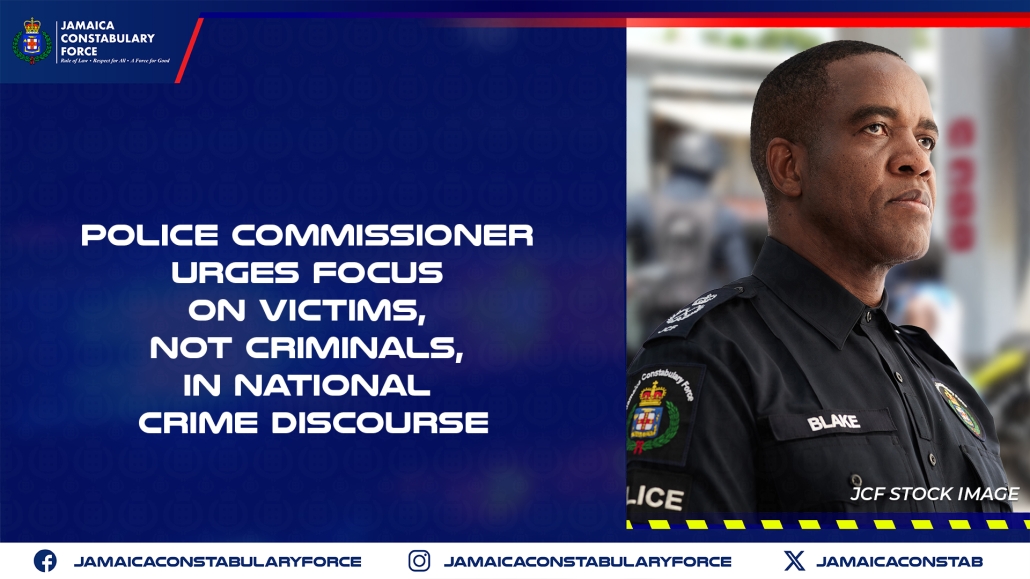
Police Commissioner Urges Focus on Victims, Not Criminals, in National Crime Discourse
Police Commissioner, Dr Kevin Blake, has called for a national shift in focus away from violent offenders and towards the innocent victims whose lives are cut short by crime, warning that public debate too often centres on the perpetrators while the people they kill remain nameless.
In a strongly worded address to members of the Jamaica Constabulary Force (JCF), published in this week’s Force Orders, Dr Blake cited a recent double murder in St James as a stark example of the human cost of violent crime.
“On Monday of this week, a 51-year-old male, and a 61-year-old female were on their way home in their car in St James, when they were attacked and murdered just because the hoodlums wanted their vehicle,” the Commissioner said.
He noted that, based on available information, the victims had done nothing to provoke the attack. “They had families, friends, loved ones, plans, resolutions, graduations to proudly attend, a future to help to build for those who depended on them, and a lot more of life to enjoy,” he said, adding that their lives were taken simply because criminals wanted their vehicle.
Dr Blake contrasted the experiences of victims with what he described as narratives that portray violent offenders as misunderstood or harmless. “These are the type of people that you are up against daily,” he told members. “These are the ones that these detractors want the society to believe would never turn their weapons against you.”
He criticised what he described as attempts by some commentators to frame heavily armed criminals as “young men who have, according to the sympathisers, ‘lost their way’, and are in need of care and opportunities”.
According to the Commissioner, such portrayals ignore the realities faced by police officers on the ground and minimise the danger posed by individuals who routinely commit acts of extreme violence.
Dr Blake also addressed public commentary surrounding fatal police shootings, including a triple fatal incident on the Mandela Highway last year, questioning the logic behind claims of unlawful conduct by officers in highly visible, high-risk environments. “The illogic of believing that we are so dumb to think that a busy highway as the Mandela, and a time as hectic as midday are ideal conditions for unlawful killings is baffling,” he said.
He added that allegations of widespread unlawful killings were particularly troubling given that an independent oversight body has full access to investigate police actions. “The illogic to believe that we are going around, risking our lives, reputation, families and freedom to carry out wanton killings… is disheartening,” the Commissioner said.
Dr Blake urged civil society groups, advocacy organisations and commentators to redirect their efforts towards discouraging armed criminals from confronting police officers. “Our time would be better spent, if these persons, groups and organisations join our voices in appealing to the murderous thugs to not raise their weapons against the police when we have to confront them,” he said.
As an example, he pointed to the recent arrest of a high-risk suspect known as Courtney ‘Bloodstain’ Ashley, who was taken into custody without loss of life. “Yet he was safely apprehended and in custody, even while trying to escape,” Dr Blake said, noting that the suspect will now have his day in court.
He added that hundreds of people are arrested each year for firearm-related offences without deadly force being used. “They presented no deadly challenge, hence we had no reason to meet them with deadly response,” he said.
The Commissioner ended his remarks with a message of reassurance to officers on the frontline, affirming his support for those who act lawfully and professionally. “You are not alone, you are not unappreciated, and you are not unsupported,” Dr Blake said. “Remain calm in the noise and confident that your leadership will always stand with you once you act within the law and in the interest of protecting life and society.”
He added that, in the end, the public would judge officers “not by the loudest voices, but by your integrity, your restraint, and your results”.