
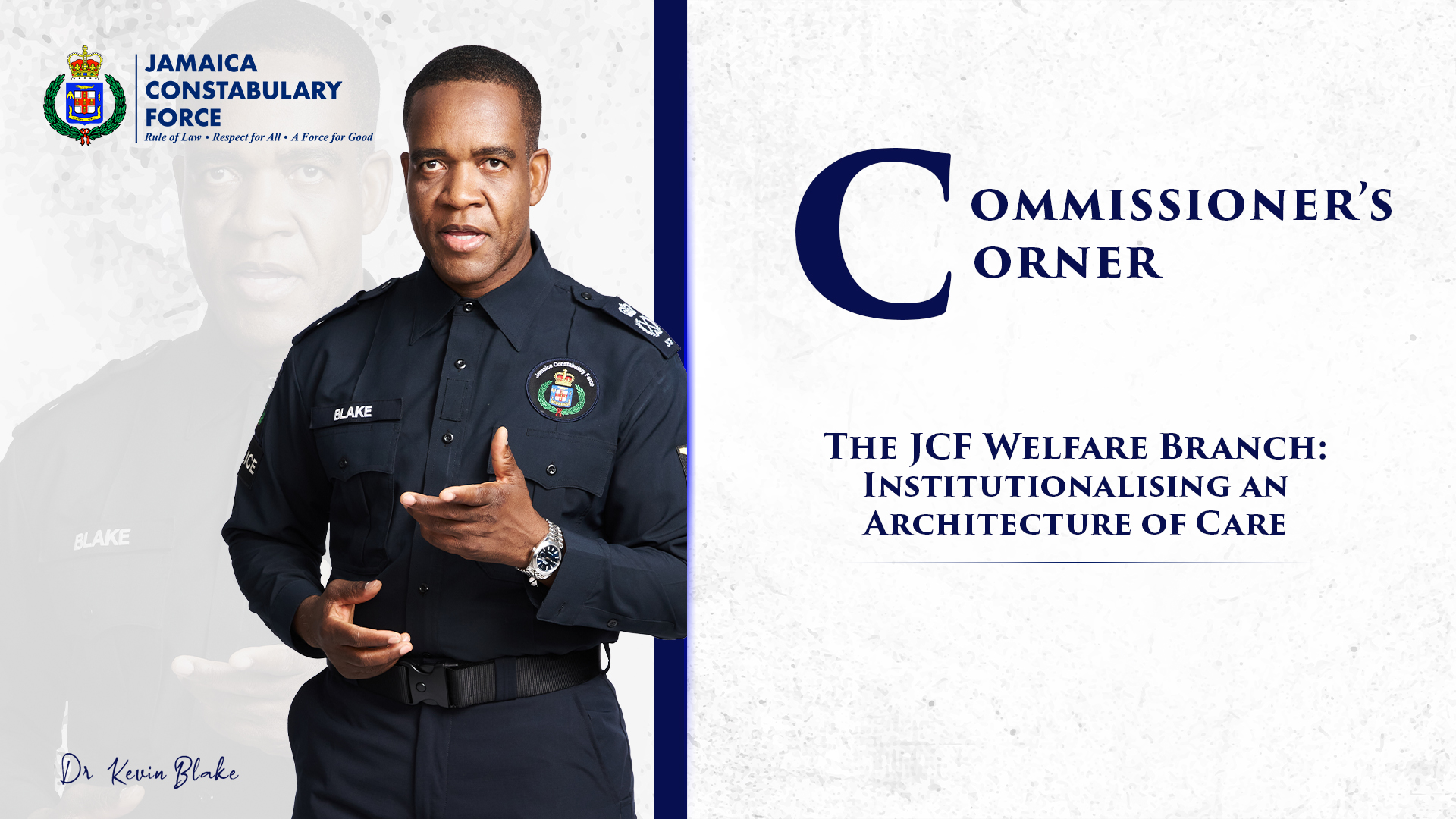
The JCF Welfare Branch: Institutionalising an Architecture of Care
Public institutions reveal their deepest convictions through structure. When an organisation alters its architecture, it declares its priorities in a way that speeches never could. In his latest column in the weekly Force Orders, Police Commissioner Dr Kevin Blake does precisely that. He signals his intention to elevate Police Welfare from Division to Branch, and in doing so, reframes how the Jamaica Constabulary Force understands care, leadership and institutional durability.
The Commissioner reminds members that this shift did not emerge casually. In a similar column in May 2024, Strategic Priority Number 4, Enhancing Staff Welfare, was unpacked deliberately. He writes that this priority is “not simply another line item on a strategic plan, but the very foundation upon which everything else we hope to achieve must stand.” That sentence carries institutional weight and positions welfare as infrastructure. It anchors crime reduction, professional policing and safer communities in the wellbeing of the people tasked with delivering them.
The logic is direct. “If we are to deliver safer communities, professional policing, and sustained crime reduction, then we must first ensure that you who are charged with this responsibility are properly supported, cared for, and valued.” Crime strategy depends on human sustainability. Operational tempo demands emotional resilience. Discipline requires stability.
Don’t get it confused. The Commissioner does not romanticise structure. He cautions against believing that organisational charts alone create care. “Structures alone, no matter how well designed, will not deliver welfare. Buildings do not care for people. Charts do not comfort a struggling colleague. Policies, by themselves, do not restore dignity.” The repetition sharpens the argument. Welfare is not mechanical. It is relational. “Welfare is ultimately about people caring for people, and about leadership that understands that responsibility cannot be delegated away.”
That insight explains the institutional leap. “Given the magnitude of this undertaken to ensure that this becomes an entrenched institutional philosophy, the formation with ownership responsibility must have a seat closer to the executive table.” The move from Division to Branch situates welfare nearer to command authority. It embeds care within decision-making. It integrates wellbeing into executive oversight.
The Commissioner is explicit about what this signals. Transforming the Welfare Division into the Welfare Branch “is not an end in itself [but a] mechanism and a signal by which the organization is saying, clearly and unapologetically, that your wellbeing matters.” Signals shape culture. Structure sustains signals. A Branch cannot be casually shifted or deprioritised. It occupies recognised space within the institutional framework. Only a Portfolio sits above it. This is permanence.
Dr Blake also widens responsibility beyond the Branch itself. “It is us reminding ourselves that it is the duty of the Jamaica Constabulary Force, not a representative body or a unit within some formation, but the institution as a whole, to look after its members.” That statement reframes welfare as corporate obligation. It dissolves the notion that care resides in a single office. It situates accountability within the entire command chain.
Commanders are therefore placed squarely within the welfare mandate. “You must see your staff welfare as a core part of your command responsibility.” The language leaves no ambiguity. Welfare belongs alongside deployments, operations and investigations. He clarifies further: “Welfare is not something to be addressed only when a crisis arises.” It must be “proactive, deliberate, and consistent.” Leadership here is preventative rather than reactive. It requires knowledge of people, awareness of pressures and timely intervention.
The Welfare Officers themselves receive clear institutional validation. “You are now an integral part of how the organization functions … the bridge between policy and people, between leadership intent and lived reality.” That framing elevates their role from administrative support to operational relevance. It ties policy to lived experience.
Perhaps the most profound passage addresses the members directly. “I encourage you to seek help whenever you need it.” The Commissioner acknowledges a truth often avoided in paramilitary cultures: “Too often our members have gone too soon because of lifestyle and stress related illnesses. The work we do is hard and sometimes takes a toll on our health.” There is no stigma in this acknowledgement. There is responsibility. “Taking care of your health – physical, mental, and emotional – must be the first order of business.”
A Force that cares deliberately strengthens its operational spine. A Force that embeds welfare in structure secures its future. The Jamaica Constabulary Force has chosen to make care permanent. The culture must now rise to meet the structure.