UNITED AGAINST CRIME JAMAICA AND TURKS & CAICOS STRENGTHEN TIES THROUGH LEVEL 2 TACTICAL TRAINING
Across the Caribbean, a new era of law enforcement collaboration is emerging. This spirit of regional partnership was on full display at the Joint Inaugural Level Two Tactical Training Graduation held on Friday, March 20, where officers from the Jamaica Constabulary Force, the Royal Turks and Caicos Islands Police Force, and the Turks and Caicos Islands Regiment came together to strengthen regional security.
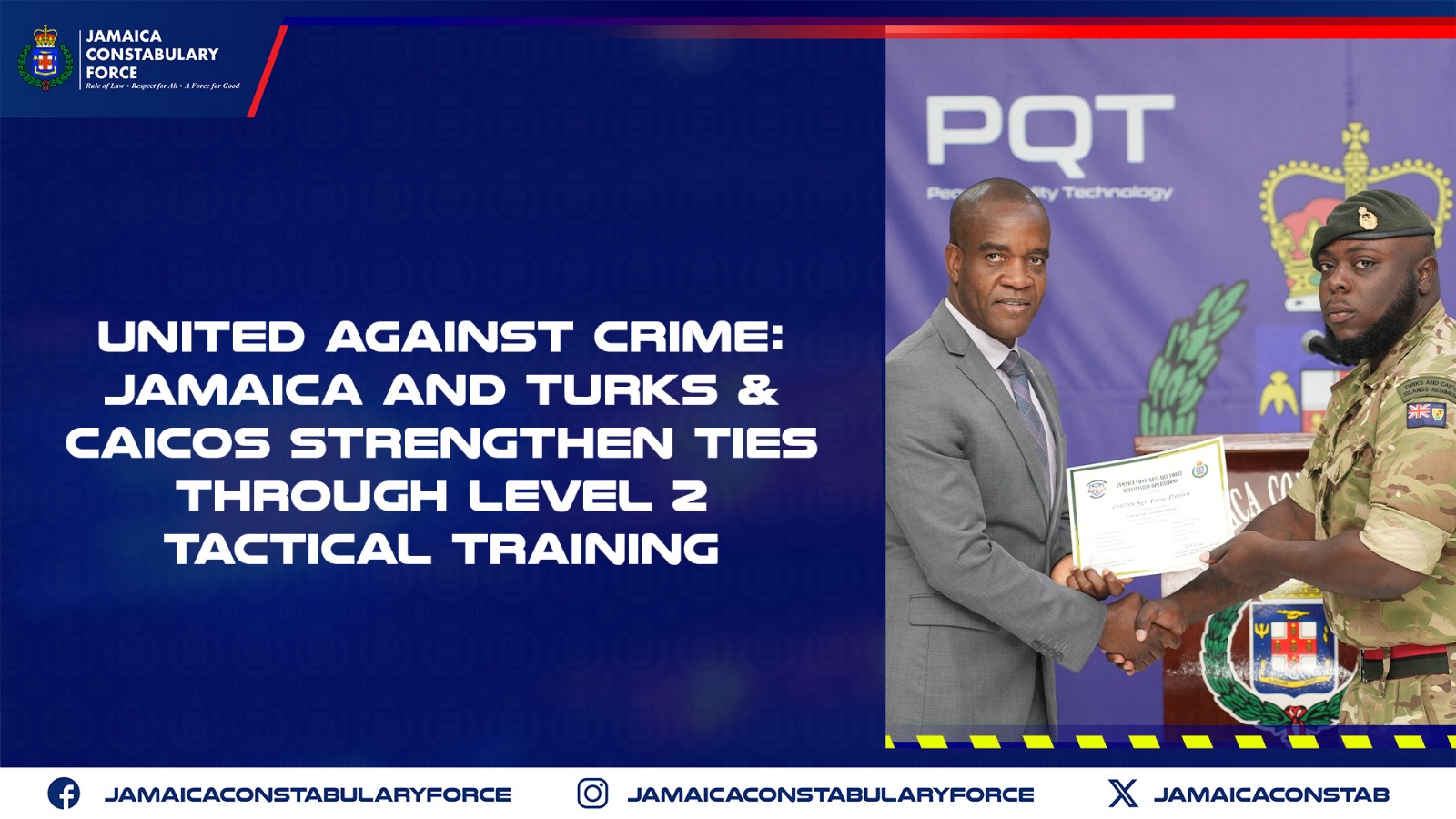
The proceedings, chaired by Assistant Commissioner of Police Gary Francis, recognised a cohort of thirty-one (31) law enforcement officers—twenty (20) from the Turks and Caicos Islands and eleven (11) from Jamaica—who successfully completed a three-week intensive programme at the Specialized Operations Tactical Academy, which commenced on Monday, March 02. The participants underwent rigorous training designed to enhance operational readiness, sharpen tactical skills, and improve coordinated responses across jurisdictions. During the ceremony, the graduates were awarded plaques and certificates for their achievements.
Among those in attendance were Deputy Prime Minister and Minister of National Security Dr. Horace Chang; Commissioner of Police of the Royal Turks and Caicos Islands Police Force Fitz Bailey; Jamaica’s Commissioner of Police Dr. Kevin Blake; Her Excellency Dileeni Daniel-Selvaratnam, Governor of the Turks and Caicos Islands; Deputy Commissioner of Police Warren Clarke, among other high-ranking officials of the JCF.
In his address, Dr. Chang emphasised that regional partnerships are critical to disrupting organised criminal groups, removing illegal firearms from circulation, dismantling criminal safe havens within illegal settlements, and improving coordination among enforcement agencies. Police Commissioners Blake and Bailey similarly highlighted the urgent need for a unified regional response to crime, noting that criminal activity increasingly transcends national borders. They also noted the complexity of transnational threats, including organised crime and human trafficking, and underlined that effective policing relies on strong partnerships, shared intelligence, and coordinated action.
Turning to the training itself, Superintendent Keisha Scott provided an overview of the programme, which combined theoretical instruction with practical exercises. Officers engaged in high-intensity drills to build resilience, communication, operational management, use-of-force protocols, teamwork, and field first aid. Delivered by experts from the Specialized Operations Branch of the JCF, the training incorporated techniques developed and tested in operational environments in Jamaica. Participants were also introduced to key doctrinal areas, including human rights and use-of-force policy, land navigation, and intelligence management, providing a comprehensive framework for modern policing.
Beyond celebrating the course completion, the graduation reflects a growing alignment among Caribbean law enforcement agencies in addressing complex, borderless threats. Joint training initiatives such as this strengthen technical capabilities while fostering professional networks essential for real-world collaboration.
As a result, the graduates will return to duty with enhanced skills, improved coordination, and a shared operational outlook. The initiative reinforces the importance of regional cooperation—built on preparation, partnership, and trust—in advancing a safer and more resilient Caribbean.
In today’s evolving security environment, where criminal networks operate beyond borders, a unified and adaptive approach to policing is paramount. Strengthening partnerships and expanding professional networks remain key to effectively confronting transnational crimes such as drug trafficking, illegal arms trade, and cybercrime. Looking ahead, the JCF remains committed to meeting emerging threats through modern strategies and sustained collaboration with regional and international partners.