
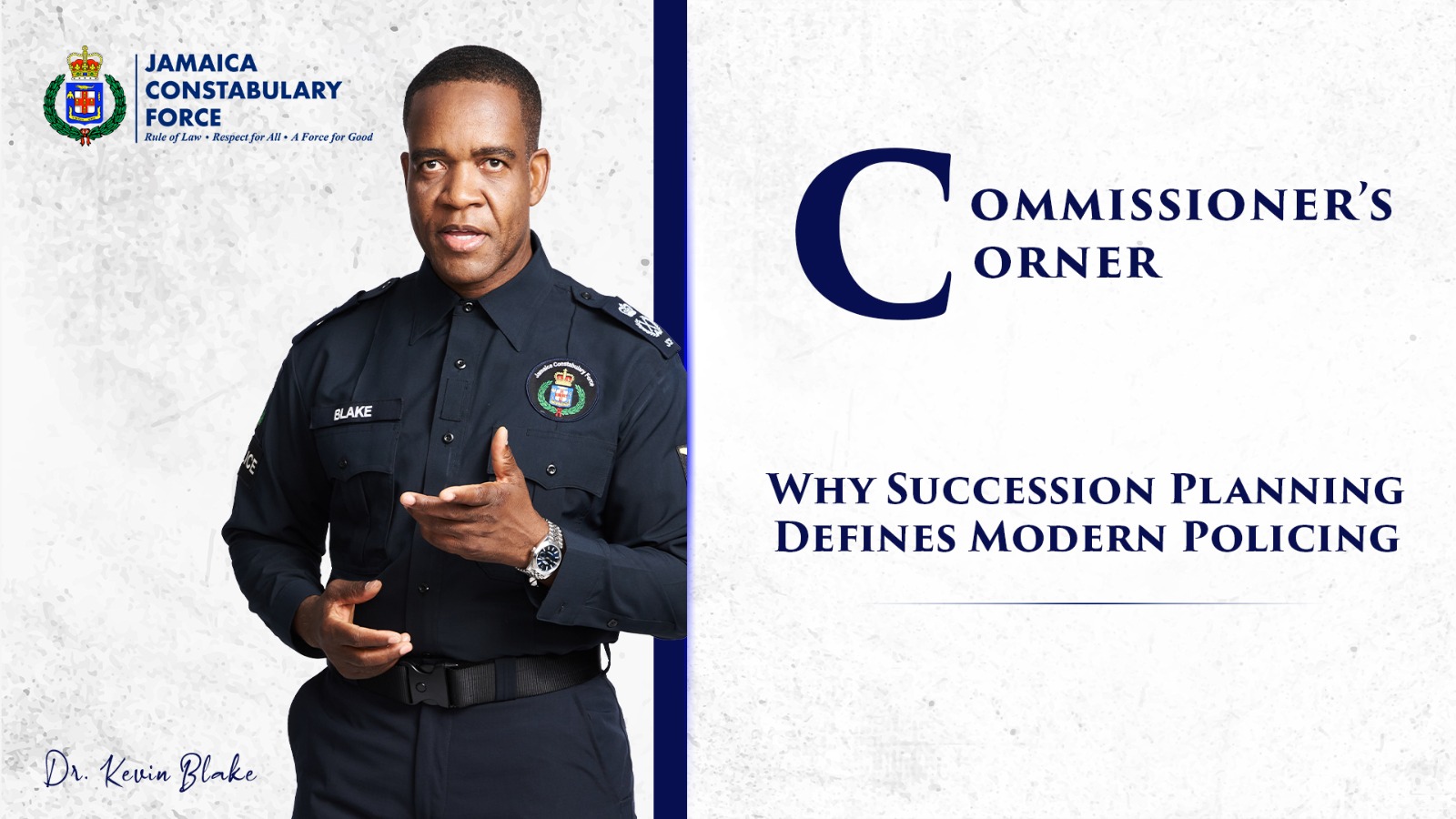
Why Succession Planning Defines Modern Policing
While institutional strength is measured by present performance, it is also measured by preparedness for what comes next. In this week’s column, Police Commissioner Dr Kevin Blake yields the platform to Deputy Commissioner of Police Andrew Lewis, and in doing so, signals something important. Leadership, in this moment of transformation within the Jamaica Constabulary Force, is being treated as a continuum rather than a position.
DCP Lewis begins by defining the concept with precision. “Succession planning is the process of identifying and developing employees to fill key leadership and critical roles, ensuring business continuity and growth.” This definition carries operational weight. Continuity and growth are not incidental outcomes. They are engineered through deliberate planning.
The structure of the process reinforces that intention. Critical roles are first identified. Competencies are assessed. Potential successors are evaluated through “performance reviews, skills assessment, and leadership evaluation.” Development follows through “training mentoring, and opportunities to gain valuable experience,” including “job rotation; leadership programmes; and acting appointments.” Each step builds readiness. Each step reduces uncertainty.
This is disciplined preparation and it reflects a shift away from reactive leadership selection toward structured leadership development. The Commissioner’s decision to give prominence to this framework indicates that the Force now sees leadership as a managed pipeline rather than an episodic occurrence.
DCP Lewis clarifies the philosophy underpinning this approach. “Succession planning is often misunderstood as simply identifying the next person to fill a role.” The correction is important. “Good succession planning is a proactive and ongoing planning process that helps organizations prepare for the future.” Preparation becomes continuous. Leadership becomes cultivated.
The implications for policing are significant. Leadership transitions carry risk. They can disrupt operations, dilute institutional memory, and slow reform. The Commissioner’s column confronts this directly. “Without proper succession planning, leadership changes could derail the significant progress that is being made by the JCF.” That sentence captures the stakes. Progress must be protected from disruption.
The JCF’s response has been to embed succession planning within its organisational systems. It is now recognised as “one of the cornerstones of effective policing.” The language is deliberate. Cornerstones support structure. They anchor stability. They ensure that transitions do not fracture the institution.
This approach also addresses a deeper institutional challenge: the preservation of knowledge. Senior leaders accumulate “decades of experience and insights that cannot be quickly replaced.” Succession planning “facilitates the transfer of knowledge and prevents detrimental gaps in decision-making and operational effectiveness.” Knowledge transfer becomes strategy. Experience becomes institutional asset.
What distinguishes the current approach within the JCF is its breadth. Succession planning is not confined to senior ranks. “Our current performance management appraisal system (PMAS), assesses not only performance but also leadership potential.” Leadership is identified early. It is developed intentionally. It is aligned with organisational needs.
This alignment is reinforced through training infrastructure. The establishment of the Faculty of Leadership and Professional Development at the National Police College of Jamaica represents a structural commitment to leadership cultivation. Training becomes a pipeline. Development becomes measurable.
The results are already visible. The Commissioner points to a “historic cohort of one hundred (100) Sergeants” who completed an Inspectors Development Programme in early 2026. This is scale. It reflects a system designed to produce leaders rather than wait for them to emerge.
The underlying objective is explicit. “Identify high-potential officers early in their careers… ensure that promotions are based on readiness and not just length of service.” This represents a cultural shift. Advancement is tied to capability. Leadership becomes earned through preparation.
The Commissioner situates this transformation within a broader global context. Police organisations worldwide are recognising that succession planning is “mission critical.” The JCF is aligning itself with that standard. It is positioning leadership development as a strategic imperative for national security.
This perspective reframes succession planning as more than internal management. It becomes a public good. Effective leadership ensures consistent service delivery. It sustains reform. It builds public trust. It secures institutional relevance.
The call to action is therefore clear. Commanders must actively identify and develop talent within their ranks. Supervisors must recognise leadership potential and nurture it deliberately. Members must engage with development opportunities and prepare themselves for greater responsibility. The organisation must continue to invest in systems that align performance, training, and progression.
Succession planning defines whether institutions endure or erode. The Jamaica Constabulary Force has chosen to build continuity. It has chosen to prepare deliberately. It has chosen to treat leadership as a strategic asset.
The future of policing will be determined by those who are ready to lead when the moment arrives.