
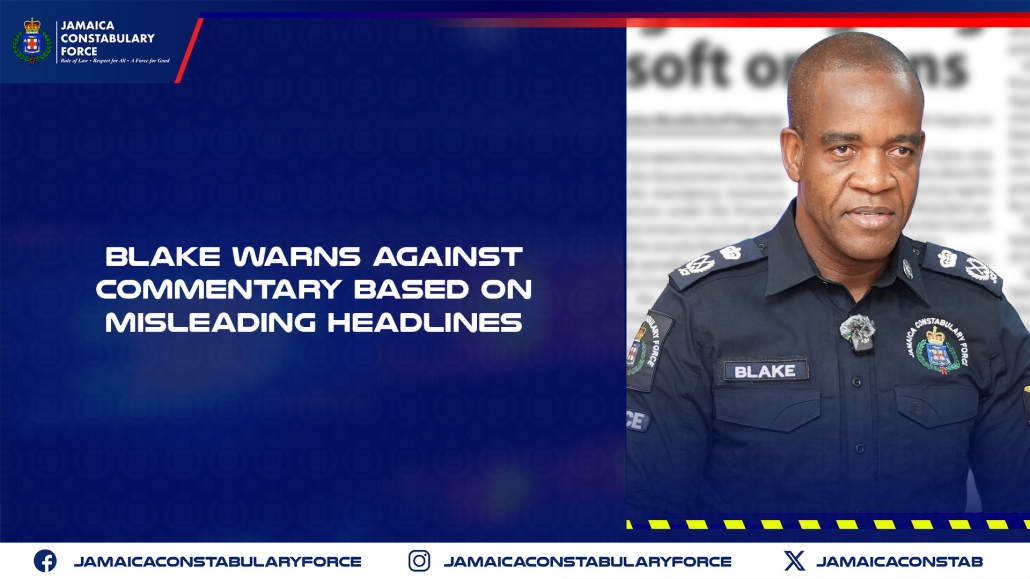
Blake Warns Against Commentary Based on Misleading Headlines
BLAKE WARNS AGAINST COMMENTARY BASED ON MISLEADING HEADLINES
Commissioner of Police Dr Kevin Blake has urged members of the public to read articles in full before commenting on them, warning that misleading headlines and distorted interpretations can create messages that were never intended.
Writing in his latest Commissioner’s Corner column, published in the weekly Force Orders, Dr Blake said the feature was created to facilitate meaningful discussion among members of the Jamaica Constabulary Force but had increasingly become the subject of wider public commentary.
“The Corner is intended for us to have meaningful discourse among ourselves as members of the JCF. However, it has become the source of much public discourse. And we have no issue with that.”
The Commissioner said difficulties arise when commentary is based on headlines or partial accounts rather than the complete text.
“There are some spaces who make their own headlines, and skew much of what is said to create different messages,” he said.
Dr Blake advised external commentators to “avoid commenting on an article that you have not read”, adding: “Read, understand, then comment.”
He made clear that he was not objecting to criticism or public discussion of the column. The Commissioner said informed responses could provide useful perspectives for the organisation.
“If you do, we may very well benefit from good feedback and suggestions that we can use,” he said.
Dr Blake placed the issue within the wider context of social media, which he said had changed the speed and reach of public communication.
He acknowledged that digital platforms allow people to mobilise assistance, educate others, share information, expose wrongdoing and bring communities together.
However, he warned that the same platforms could be used to spread false or malicious information and manufacture controversy in pursuit of online engagement.
“There are those who have chosen to use these platforms not to inform but to misinform; not to build but to destroy; not to contribute meaningfully to public discourse but to manufacture controversy,” he said.
“Some seem to measure success by the number of likes, shares, views and followers they can accumulate, even when what they are circulating is false, malicious or deliberately misleading.”
The Commissioner also cautioned against treating popularity or wide circulation as evidence that information is accurate.
“The fact that something is circulating widely does not make it true,” he said. “The fact that someone has thousands of followers does not make them credible. And the fact that a story is sensational does not make it worthy of our attention.”
Dr Blake urged social-media users to exercise greater responsibility when publishing or circulating information.
“We should therefore exercise some maturity in what we post, what we repeat and what we share,” he said.
The Commissioner also told JCF members that they must remain receptive to legitimate criticism while refusing to become distracted by every rumour, provocative post or online controversy.
“We must see the environment in which we operate, understand the challenges we face, listen to legitimate criticism and remain alert to emerging threats and opportunities,” he said.
“But having seen all of that, we must still be able to keep our eyes on the destination.”
Dr Blake described this approach as “blinkered focus”, which he said required members to determine which issues deserved their attention while remaining guided by facts, the values of the organisation and its mission.
“Not everything that is said about us deserves a response,” he said. “Not every rumour deserves our attention. Not every social-media post deserves to become a matter of discussion in the workplace.”
He added: “Sometimes the most disciplined response is no response at all.”