
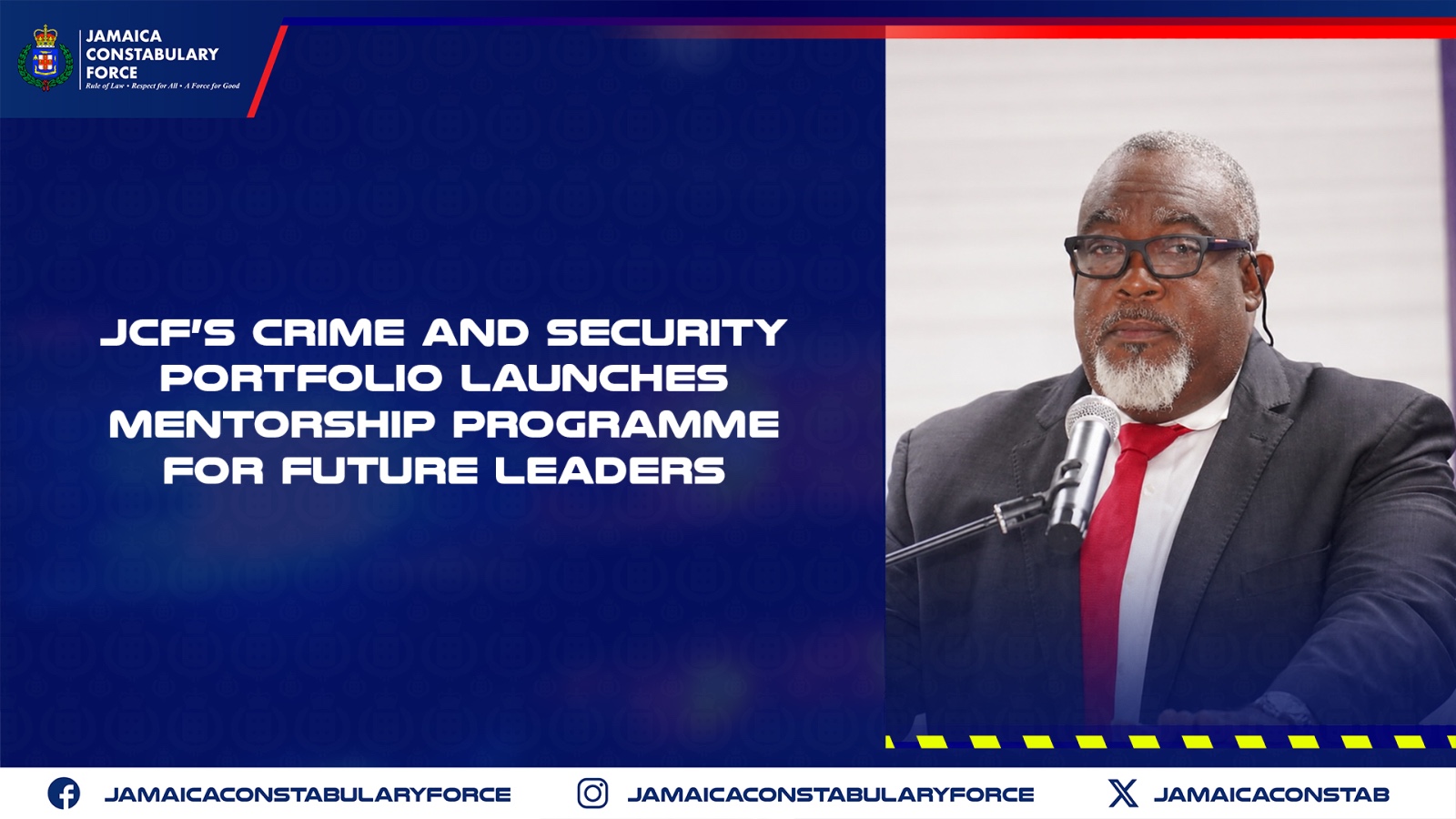
JCF’S CRIME AND SECURITY PORTFOLIO LAUNCHES MENTORSHIP PROGRAMME FOR FUTURE LEADERS
The Jamaica Constabulary Force’s (JCF) Crime and Security Portfolio (CSP) is enhancing its investment in its most important resource – its people – with the launch of a pilot mentorship programme aimed at fostering continuous learning, institutional knowledge transfer and strengthening the pipeline of future JCF leaders.
The six-month CSP Mentorship Programme was launched on Wednesday, August 26, under the theme “Empower, Elevate, Excel: Unlocking Potential through Mentorship” and paired 21 experienced members of the Portfolio with 42 junior ranks as part of the Portfolio’s wider succession-planning initiatives.
For the JCF, mentorship goes beyond a professional development programme, it connects different generations within the organisation, ensuring that lessons, experiences and expertise gained over years of policing are passed on while also creating room for new ideas, innovation and leadership.
The programme is based on the idea that to be effective policemen and women, officers need more than technical ability; they also need good judgement, resilience, professionalism, accountability and the capacity to learn from those who have already dealt with the complexities of the job.
The programme will have three main stages: onboarding and goal-setting, skill development and knowledge sharing, followed by progress review, reflection and closure.
In the onboarding phase, mentors and mentees will identify skill gaps and growth opportunities and set clear career and professional development objectives which follow the SMART criteria (specific, measurable, achievable, relevant and time-bound). In the second phase, the emphasis will be on practical development, achieved through targeted coaching, knowledge-sharing sessions, hands-on projects and job-shadowing opportunities.
The final stage will allow the programme’s committee to evaluate progress, identify areas that still need development and decide how the lessons learned from the mentorship can be put into practice beyond the six-month pilot period.
Branch heads within the Portfolio – Assistant Commissioners of Police Kirk Ricketts, Anthony McLaughlin and Wayne Josephs, as well as Acting Assistant Commissioner of Police Christopher Brown will provide guidance, oversight and the necessary resources to ensure its successful implementation.
Head of the CSP, Deputy Commissioner of Police (DCP) Richard Stewart, said he looks forward to seeing the results of the partnership among the programme participants.
“It is well understood and accepted that in this era, critical thinking is an important element, but even more so, the way we go about teaching and passing on information has to be changed within this current paradigm. The mentorship programme is an example of this change; we anticipate that our mentors will not just pass on broad knowledge but will assist in developing the type of attitude that is needed for success within the CSP,” said DCP Stewart. “I anticipate the relationship to be symbiotic; both mentors and mentees will benefit, so that we do not have a deficit.”
By committing to a culture of shared growth, continuous learning and support, the CSP is taking proactive steps as the JCF becomes a stronger, more agile Force for good.