
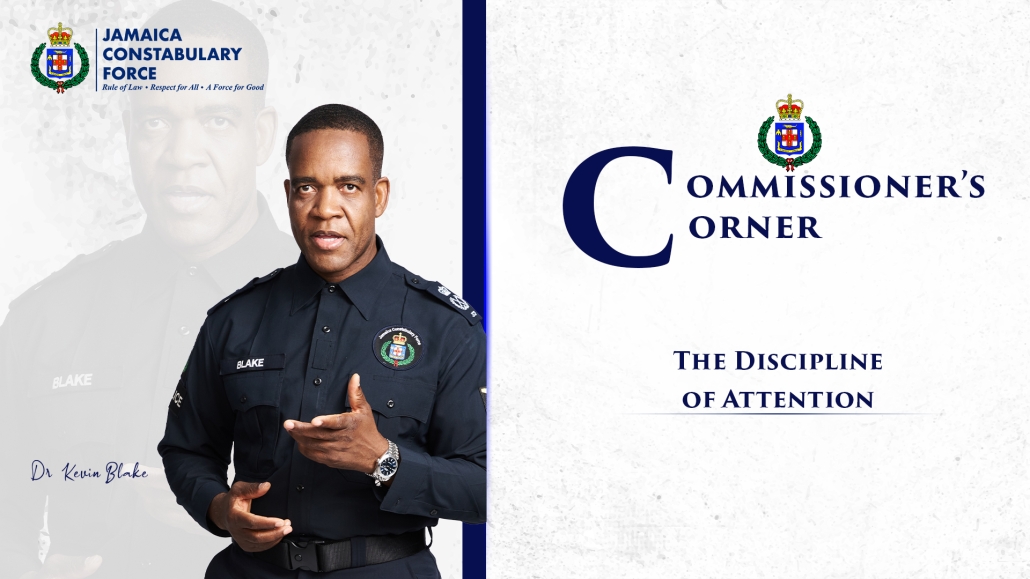
THE DISCIPLE OF ATTENTION
The internet distributes information and competes aggressively for attention. Content that provokes anger, confirms suspicion or invites immediate judgement often travels furthest. For public institutions, this creates a demanding question; how should they remain responsive to legitimate criticism without allowing every online controversy to dictate their priorities?
Police Commissioner Dr Kevin Blake addresses that question in his latest Commissioner’s Corner. He calls his approach “blinkered focus” and takes care to define it. “I am not suggesting that we become incapable of seeing what is happening around us,” he writes. “Quite the opposite.”
The distinction matters. An effective police organisation must understand the society in which it operates and remain receptive to criticism. Dr Blake states that obligation directly: “We must see the environment in which we operate, understand the challenges we face, listen to legitimate criticism and remain alert to emerging threats and opportunities.” Awareness, however, must be accompanied by direction. “Having seen all of that,” he adds, “we must still be able to keep our eyes on the destination.”
Focus, in this sense, is an act of institutional discipline. It does not arise automatically from having a mission statement or strategic plan. The Commissioner argues that “blinkered focus is not something we wish for and then hope will happen. It requires deliberate effort.”
That effort becomes harder in an environment where information circulates almost instantaneously. Dr Blake recognises the value of social media, noting that people can now “mobilize assistance, educate, share information, expose wrongdoing, celebrate achievements and bring people together” on a scale unavailable to earlier generations. These platforms can serve the public interest, including the work of accountability.
The same technology can reward distortion. The Commissioner warns of people who use social media “not to inform but to misinform; not to build but to destroy; not to contribute meaningfully to public discourse but to manufacture controversy.” Their success may be measured in “likes, shares, views and followers,” even where the content being circulated is “false, malicious or deliberately misleading.”
This problem is intensified when commentary becomes detached from its source. Commissioner’s Corner was created as a forum for communication with members of the JCF, although the column now generates wider public discussion. Dr Blake says some platforms “make their own headlines, and skew much of what is said to create different messages.” His advice is basic but necessary: “Read, understand, then comment.”
The principle extends beyond this particular column. Informed criticism begins with an accurate account of what was said or done. When reaction precedes understanding, public debate becomes vulnerable to selective quotations, invented motives and conclusions built upon incomplete information. Dr Blake leaves room for criticism grounded in the full facts, observing that the Force “may very well benefit from good feedback and suggestions that we can use.”
The JCF must therefore distinguish useful criticism from content designed mainly to provoke. “Not everything that is said about us deserves a response,” the Commissioner writes. “Not every rumour deserves our attention. Not every social-media post deserves to become a matter of discussion in the workplace.”
That is a question of resource allocation. A police force has finite time, personnel and mental capacity. Attention devoted to every rumour or provocative post is diverted from other responsibilities. Dr Blake identifies those responsibilities plainly: “There is crime to fight. There are communities to reassure. There are victims to support. There are young people to influence. There are systems to improve.”
His warning against giving “oxygen to fools with microphones and followers” is deliberately sharp. It should not become a licence to dismiss uncomfortable reporting or credible allegations. The Commissioner himself establishes the boundary: members should “take legitimate criticism seriously” while refusing to allow “malicious noise” to occupy their minds.
The difficulty lies in telling the difference. Virality provides no reliable test. “The fact that something is circulating widely does not make it true,” Dr Blake observes. “The fact that someone has thousands of followers does not make them credible. And the fact that a story is sensational does not make it worthy of our attention.”
He also recognises that public servants must submit their official conduct to scrutiny. “The public has a legitimate interest in how we perform our functions, how we exercise our authority and whether we uphold the standards expected of us,” he writes. That accountability has boundaries. “Being a public servant does not mean that every aspect of your private life becomes public property.”
The Commissioner describes this as the difference between “public accountability and public entitlement.” It is an important distinction in an online culture where curiosity can be presented as public interest and personal exposure can be confused with scrutiny.
Maintaining focus amid online controversy requires judgement about when to listen, when to answer, when to correct and when to keep working. “Sometimes the most disciplined response is no response at all,” Dr Blake writes. The final responsibility is clear: “There will always be noise. Let us not become part of it.”