
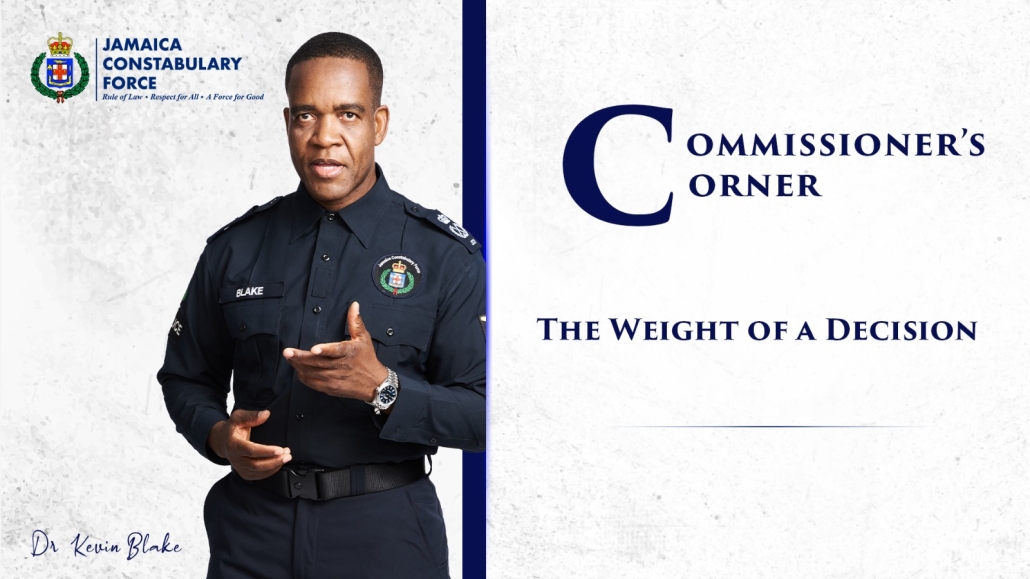
THE WEIGHT OF A DECISION
Leadership is often described through the language of authority: the power to direct, the
responsibility to command and the capacity to determine what happens next. Less attention is
paid to its personal cost. The hardest decisions rarely arise when the facts are simple and the
people involved are strangers. They arise when duty collides with familiarity, when institutional
responsibility demands action involving a colleague, and when every available course carries
consequences.
This is the territory Police Commissioner Dr Kevin Blake enters in his latest Commissioner’s
Corner. His reflections come as the Jamaica Constabulary Force faces scrutiny arising from
allegations involving some of its members. He neither prejudges those allegations nor attempts to
minimise their effect. Instead, he examines the obligations of leadership when individual conduct
threatens confidence in the institution.
“Some decisions do not simply affect an individual or a particular operation. Some have
consequences for the reputation and credibility of the entire institution.”
That distinction matters. Leaders routinely make decisions about assignments, resources,
operations and personnel. Their effects are usually contained. A decision taken in response to
alleged wrongdoing carries a different weight. It communicates what the institution will tolerate,
whose interests it will protect and whether its declared standards remain operative when applying
them becomes uncomfortable.
Institutional credibility is tested most severely when accountability reaches people of rank,
influence or long service. Principles are easy to affirm in the abstract. Their meaning becomes
apparent when they require a leader to act in circumstances complicated by professional
relationships and shared experience.
Dr Blake acknowledges this without sentimentality. “Leadership is often most difficult when the
decisions we have to make directly affect people with whom we have worked, served, struggled,
and shared experiences,” he writes.
Police organisations develop strong internal bonds for understandable reasons. Officers depend
upon one another in dangerous situations. They share risks that few outside the profession
experience and often endure public criticism collectively. Loyalty grows from these conditions. It
can sustain officers through trauma and uncertainty.
Yet loyalty becomes dangerous when it overrides judgement. A leader who permits personal
attachment to determine an institutional response ceases to exercise authority impartially. The
resulting decision may protect one person temporarily, but it exposes every other member of the
organisation to the consequences.
The Commissioner therefore establishes a clear standard: “Leadership cannot be guided by rank,
seniority, popularity, or fear of criticism. Leadership must be guided by principle.”
Principle, in this context, requires more than severity. A principled response must preserve
accountability while respecting due process. It must take allegations seriously without presenting
them as settled facts. It must protect the institution without using institutional reputation as a
reason to shield individuals from legitimate investigation.
Dr Blake recognises both obligations. The JCF, he argues, “must confront wrongdoing wherever it
exists,” but must also reject the temptation to allow “allegations to become convictions in the
court of public opinion.” His formulation is concise: “We must be fair and firm. We must be lawful,
and above all, be principled.”
Fairness and firmness are related duties. Firmness without fairness becomes arbitrary. Fairness
without the willingness to act can become an excuse for paralysis. Responsible leadership
requires decisions that are proportionate, procedurally sound and capable of withstanding
scrutiny after the pressure of the immediate moment has passed.
The consequences extend beyond those directly implicated. Police officers exercise considerable
powers on behalf of the state. Their effectiveness depends partly upon public cooperation.
Witnesses must be prepared to speak, communities must be willing to share information, and
citizens must believe that police authority will be exercised lawfully.
“The public does not always distinguish between the individual and the institution,” the
Commissioner observes. “When one member falls short, people can begin to question all of us.”
This may appear unfair to the many officers who serve honestly, but it is an unavoidable feature of
institutional life. The uniform, rank and authority connect an officer’s conduct to the organisation.
Senior officers carry an even greater burden because their decisions help establish the ethical
boundaries within which others operate.
The same collective identity that gives an officer authority also distributes the consequences of
misconduct. One allegation can affect thousands of members who had no connection to the
events in question. Their encounters with the public may become more difficult. Their motives
may be treated with greater suspicion. This is why the Commissioner insists that “integrity cannot
be negotiable.”
His argument also challenges a familiar misunderstanding of institutional loyalty. “Standing with a
colleague cannot come at the expense of standing for the institution,” he writes. “Supporting our
members does not mean shielding wrongdoing. Caring for our colleagues does not mean
compromising accountability.”
Colleagues facing allegations retain their legal rights, human dignity and entitlement to fair
treatment. They may require welfare support and access to processes that protect them from
arbitrary action. None of this requires the organisation to suspend its standards or frustrate
legitimate scrutiny.
An institution that shields wrongdoing does not protect its members. It transfers the cost to those
who continue to serve honourably. They must work beneath the suspicion created by conduct
they did not commit and decisions they did not make.
Official statements can explain an institutional response, but they cannot supply the credibility
that conduct has depleted. As Dr Blake states, “Trust is not rebuilt by words alone. Trust is rebuilt
by consistent behaviour.”
Leadership carries the heavier burden because its decisions tell members what the institution truly
values. When relationships are close and criticism is inevitable, the leader must determine which
obligations cannot be surrendered.
That is the weight of a decision; it falls first upon the person who makes it, but its consequences
are carried by the entire institution.