
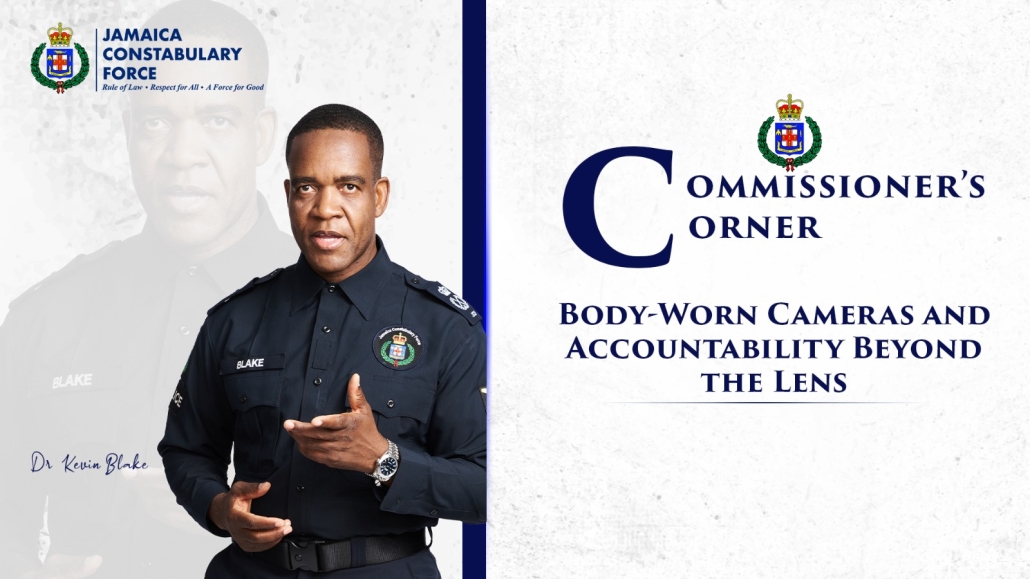
Body-Worn Cameras and Accountability Beyond the Lens
Public debates often develop around symbols. Complex issues become attached to a single image, a single policy, or a single technology. Over time, the symbol begins to carry more weight than the underlying issue itself. In contemporary policing, few technologies have acquired greater symbolic significance than the Body-Worn Camera (BWC). For many citizens, the camera has become synonymous with accountability. Its presence signals transparency. Its absence raises suspicion. Its footage is increasingly viewed as the definitive pathway to truth.
The attraction of this logic is understandable. Cameras capture what the human eye may miss. They preserve events in real time. They reduce disputes about what occurred. They strengthen investigations and frequently protect both police officers and citizens from false allegations.
Yet Police Commissioner Dr Kevin Blake’s latest Commissioner’s Corner raises an important question: has the public conversation become so focused on the camera that it risks overlooking the broader foundations upon which accountability rests?
The first point raised by the Commissioner addresses what he sees as a growing disconnect between perception and reality. Despite sustained criticism suggesting institutional resistance to BWCs, he points to evidence that tells a markedly different story.
“The JCF has invested approximately $2 billion in the infrastructure necessary to support BWCs. To date, we have procured approximately 1,750 cameras and deploy roughly 1,500 daily.”
The significance of this statement extends beyond the figures themselves. It speaks to a broader challenge increasingly present within public discourse: the tendency for narratives to become detached from empirical evidence. The Commissioner is not arguing that the BWC programme is complete. Nor is he suggesting that legitimate questions cannot be raised regarding implementation timelines or deployment priorities. Rather, he is making a distinction between debating the pace of implementation and questioning the existence of commitment.
This distinction matters because effective public oversight depends upon accurate diagnosis. A conversation about how quickly cameras should be deployed differs fundamentally from a conversation about whether an organisation supports their use at all. The Commissioner appears concerned that these two discussions have become conflated.
This observation leads directly into what is arguably the central argument of the entire column. Dr Blake notes that BWCs are frequently presented as “the principal explanation for why relatively few fatal police shootings result in criminal charges being laid against officers.”
This is a remarkably important observation because it reflects a broader international trend. Across many democratic societies, body-worn cameras have evolved from an investigative tool into a symbolic measure of legitimacy itself. Public confidence increasingly becomes attached to the existence of footage rather than the totality of evidence available to investigators.
The distinction may appear subtle, but it carries profound implications. A camera is a source of evidence. Accountability is a principle. The former can strengthen the latter, but the two are not interchangeable. By raising this point, the Commissioner invites the public to examine whether accountability has gradually become understood through an overly narrow technological lens.
The most intellectually provocative section of the column emerges when the Commissioner compares investigations into fatal police shootings with investigations into murders committed by criminals.
“When a police officer is involved in a fatal shooting,” he explains, investigators generally begin with several significant advantages. The officer provides a statement. The firearm is surrendered for forensic examination. Investigators gain immediate access to information surrounding the incident. The scene is available for processing and witnesses are often identified quickly.
The comparison that follows is particularly striking. When investigators pursue criminal offenders, they frequently begin without any of these advantages. Suspects refuse to cooperate. Weapons disappear. Witnesses become fearful or remain silent. Evidence must be painstakingly assembled over extended periods.
The Commissioner’s objective here is not to diminish the importance of BWCs. Instead, he is drawing attention to a broader question about investigative capacity. How should society evaluate the effectiveness of investigations when substantial evidence exists beyond video footage? What weight should be assigned to witness testimony, forensic examination, scene reconstruction and other investigative techniques?
These questions become even more salient when viewed alongside another statistic highlighted by the Commissioner. “Yet despite these challenges, the JCF achieved a murder clear-up rate (cases solved) of approximately 91% in 2025.”
This figure serves as the foundation for the most challenging question posed within the article. “If most fatal police shootings are indeed questionable, as is often implied in public discourse, why do so few investigations result in criminal charges?”
Whether one agrees with the Commissioner’s reasoning or not, the question deserves serious consideration. At its core lies a debate about evidence and investigative standards. If investigators are capable of solving the overwhelming majority of murders without the benefit of video footage, should the absence of BWC footage be viewed as an insurmountable obstacle in police shooting investigations?
The Commissioner reinforces this point through a deliberately provocative comparison. “The reason given for not being able to lay more charges is the absence of BWC footage. My question is, would anyone accept that from me as a reason for not being able to properly investigate murders?”
The value of this question lies not in the answer it demands, but in the assumptions it forces us to examine.
Modern justice systems have never depended exclusively on video evidence. Courts routinely evaluate witness testimony, forensic findings, ballistics, expert opinions and circumstantial evidence. Investigators establish facts through the cumulative weight of multiple forms of evidence rather than reliance upon a single source.
This brings us to what may be the Commissioner’s most consequential observation. “Accountability existed before BWCs and must continue to exist even when no footage is available.” In many respects, this sentence captures the philosophical core of the entire column.
The Commissioner is defending a conception of accountability that is institutional rather than technological. It is rooted in independent investigations, evidentiary standards, forensic competence and professional oversight. Cameras strengthen those systems. They improve transparency. They enhance public confidence. They often provide invaluable evidence.
Importantly, the Commissioner leaves no ambiguity regarding his support for BWCs themselves. He describes them as a tool that “enhance transparency, strengthen accountability, protect officers from false allegations, protect citizens from misconduct, and improve public confidence.”
The Commissioner’s latest column asks Jamaicans to consider not only the value of body-worn cameras, but also the foundations upon which accountability itself rests.
The answer may ultimately determine whether the national conversation remains focused on technology or evolves into a more mature discussion about evidence, oversight and justice.