

Greetings again my distinguished Colleagues,
I trust that you have been having a great week at home and at work. May is now behind us and our focus shifts to June, the final month of the second quarter.
Traditionally, May has been the month with the highest number of murders, averaging well over 130. Last year, for the first time in more than 31 years, 53 murders were recorded in May. This year, May ended with 39 murders, joining March as the second-lowest monthly murder figure recorded in over three decades.
Colleagues, these achievements are not accidental. They are the product of sacrifice, commitment, sound strategy, and the daily courage displayed by you our members. They have been achieved while operating in an environment of intense public scrutiny and criticism. Some of that criticism is fair and deserved, and we must always be willing to confront our shortcomings honestly. Other criticisms, however, are based on assumptions, incomplete information, or narratives that do not stand up to objective examination.
Today I will once again revisit the topic of Body Worn Cameras (BWCs). I am sorry if I make the detractors who wish to have their narrative dominate the information space, tired. However, I am compelled to respond as there remains a persistent narrative that the Jamaica Constabulary Force is resistant to the use of BWCs. Respectfully, the evidence does not support such a conclusion. The JCF has invested approximately $2 billion in the infrastructure necessary to support BWCs. To date, we have procured approximately 1,750 cameras and deploy roughly 1,500 daily. We have established detailed policies governing their use, and the deployment and utilization of BWCs form part of our regular operational reviews, chaired by a Deputy Commissioner of Police.
I will endeavour to keep this week’s discourse short because I want the full script to be read by those who like to comment on headlines and lay themselves vulnerable to being manipulated. Reasonable persons may disagree with our pace of implementation, our deployment priorities, or the number of cameras currently available. Those are legitimate discussions. What is more difficult to understand, however, is the continued suggestion that the organization is resisting a technology in which it has invested so heavily and continues to expand.
Colleagues, one of the reasons this discussion is important is because BWCs are often presented as the principal explanation for why relatively few fatal police shootings result in criminal charges being laid against officers. As Commissioner of Police, I believe the Jamaican people deserve a broader examination of this issue.
When a police officer is involved in a fatal shooting, the independent investigators generally begin with several significant advantages. The officer is required to provide a statement, most times without the benefit of time allowed to recover from the trauma. The firearm used is made available for forensic examination. Investigators have immediate access to information regarding the circumstances surrounding the incident. The scene is available for processing and witnesses are often identified quickly, some who were never even present. This that they have from the onset, is most of what is required to complete an investigation.
By contrast, when JCF investigators are called upon to investigate a murder committed by criminals, they rarely begin with any of those advantages. The suspect seldom provides a statement. The weapon used is often never recovered. There is usually no official account of what transpired. Witnesses are frequently fearful, reluctant, or entirely absent. In many cases, investigators are forced to reconstruct events from fragments of evidence gathered over weeks or months.
Yet despite these challenges, the JCF achieved a murder clear-up rate (cases solved) of approximately 91% in 2025. This reality raises an important question for public consideration. Over the last five years, approximately 2%, or 20 cases of fatal police shooting investigations have resulted in criminal charges being laid against officers. Of this number, 9 were off duty in their private capacity. It means that approximately 1% of the cases investigated where police officers were on duty, resulted in charges. It is to be noted as well that there has not been a single conviction resulting from a fatal shooting case over the 5 year period. At the same time, the public is frequently told that many of these incidents are questionable and that the absence of body-worn camera footage significantly impedes the ability to arrive at definitive conclusions.
If most fatal police shootings are indeed questionable, as is often implied in public discourse, why do so few investigations result in criminal charges? This is not a rhetorical question. It is a legitimate question. If investigators are routinely presented with a shooting that appears unlawful, while simultaneously possessing a statement from the officer involved, access to the firearm used, the incident scene, witness accounts, and reports surrounding the event, should the outcomes not more frequently reflect that concern? Conversely, if the overwhelming majority of investigations do not produce evidence sufficient to support criminal charges, should this not also inform how these incidents are characterized publicly? The reason given for not being able to lay more charges is the absence of BWC footage. My question is, would anyone accept that from me as a reason for not being able to properly investigate murders? Colleagues, I strongly doubt that we had video footage for any of the 91% of murders solved last year.
Let me be clear, lest the headlines suggest that I am pushing back at BWC. I fully support the expansion of BWCs across the Force. BWCs enhance transparency, strengthen accountability, protect officers from false allegations, protect citizens from misconduct, and improve public confidence. The JCF remains committed to expanding their use and ultimately achieving full operational integration.
However, accountability cannot depend exclusively on camera footage. Accountability existed before BWCs and must continue to exist even when no footage is available. If accountability becomes impossible in the absence of video evidence, then countless criminal investigations across Jamaica would similarly be impossible.
The Jamaican people deserve both transparency and balance. They deserve confidence that allegations against police officers are thoroughly investigated. They also deserve confidence that conclusions are based on evidence rather than assumptions, and that public commentary accurately reflects investigative outcomes.
As Commissioner, I will continue to support any effort that strengthens accountability, professionalism, and public trust. I will also continue to ask difficult questions whenever the facts suggest that they should be asked. It must be noted that the JCF cannot investigate police fatal shootings, and so I depend on the independent body to be effective. If these incidents are indeed questionable, I rely on them to help to remove these individuals from within our midst. That is the service that they deliver, on which I depend. In other words, I am their client.
Colleagues, while I make these points, let us remember that a single incident where someone has unjustifiably lost their life by the hands of the police is one too many. And so, let us continue to carry out our duties with professionalism and respect for the rule of law. We must, however, not shrink back from our responsibility to boldly face down criminals in ensuring safety and security in our communities.
Let me wish for you and your families a peaceful and blessed weekend. Until next week, walk good.
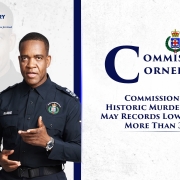
Police Commissioner Dr Kevin Blake has hailed members of the Jamaica Constabulary Force (JCF) after Jamaica recorded its lowest number of murders for the month of May in more than three decades.
In his weekly column published in Force Orders, Dr Blake revealed that 39 murders were recorded during May 2026, a significant reduction from the figures historically associated with what has traditionally been the country’s most violent month. “Traditionally, May has been the month with the highest number of murders, averaging well over 130,” the Commissioner noted.
He pointed out that May 2025 had already marked a historic milestone when 53 murders were recorded; the first time in more than 31 years that the figure had fallen to that level. However, he said the latest figures represented an even more significant achievement. “This year, May ended with 39 murders, joining March as the second-lowest monthly murder figure recorded in over three decades,” Dr Blake stated.
The Commissioner attributed the decline to the commitment and professionalism of the men and women of the JCF, emphasising that the results were earned through sustained effort rather than chance. “These achievements are not accidental. They are the product of sacrifice, commitment, sound strategy, and the daily courage displayed by you our members,” he said.
Dr Blake commended members across the organisation for maintaining their focus while operating under what he described as intense public scrutiny. “They have been achieved while operating in an environment of intense public scrutiny and criticism,” he said.
The Commissioner acknowledged that some criticism directed at the organisation is justified and necessary for continued improvement. “Some of that criticism is fair and deserved, and we must always be willing to confront our shortcomings honestly,” he noted.
At the same time, he urged members not to become discouraged by narratives that may not accurately reflect the realities of policing and crime reduction efforts. “Other criticisms, however, are based on assumptions, incomplete information, or narratives that do not stand up to objective examination,” Dr Blake said.
The Commissioner encouraged members to remain focused on their mission and continue building on the progress that has been achieved.
Jamaica is currently registering a 22 percent reduction in murders accompanied by significant declines across several other major crime categories. Year-to-date figures show shootings have fallen by 30 per cent, robberies by 24 per cent, and rapes by 15 per cent when compared with the corresponding period last year.
Overall, major crimes continue to trend downward, reflecting the impact of targeted policing strategies, enhanced operational coordination, and sustained efforts to disrupt criminal networks and remove illegal firearms from Jamaica’s communities.
Dr Blake said the latest figures demonstrate what can be achieved when dedicated police personnel execute sound strategies with discipline and consistency, while remaining committed to the Force’s mandate of serving and protecting the people of Jamaica.
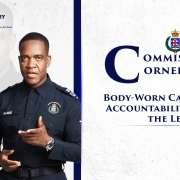
Public debates often develop around symbols. Complex issues become attached to a single image, a single policy, or a single technology. Over time, the symbol begins to carry more weight than the underlying issue itself. In contemporary policing, few technologies have acquired greater symbolic significance than the Body-Worn Camera (BWC). For many citizens, the camera has become synonymous with accountability. Its presence signals transparency. Its absence raises suspicion. Its footage is increasingly viewed as the definitive pathway to truth.
The attraction of this logic is understandable. Cameras capture what the human eye may miss. They preserve events in real time. They reduce disputes about what occurred. They strengthen investigations and frequently protect both police officers and citizens from false allegations.
Yet Police Commissioner Dr Kevin Blake’s latest Commissioner’s Corner raises an important question: has the public conversation become so focused on the camera that it risks overlooking the broader foundations upon which accountability rests?
The first point raised by the Commissioner addresses what he sees as a growing disconnect between perception and reality. Despite sustained criticism suggesting institutional resistance to BWCs, he points to evidence that tells a markedly different story.
“The JCF has invested approximately $2 billion in the infrastructure necessary to support BWCs. To date, we have procured approximately 1,750 cameras and deploy roughly 1,500 daily.”
The significance of this statement extends beyond the figures themselves. It speaks to a broader challenge increasingly present within public discourse: the tendency for narratives to become detached from empirical evidence. The Commissioner is not arguing that the BWC programme is complete. Nor is he suggesting that legitimate questions cannot be raised regarding implementation timelines or deployment priorities. Rather, he is making a distinction between debating the pace of implementation and questioning the existence of commitment.
This distinction matters because effective public oversight depends upon accurate diagnosis. A conversation about how quickly cameras should be deployed differs fundamentally from a conversation about whether an organisation supports their use at all. The Commissioner appears concerned that these two discussions have become conflated.
This observation leads directly into what is arguably the central argument of the entire column. Dr Blake notes that BWCs are frequently presented as “the principal explanation for why relatively few fatal police shootings result in criminal charges being laid against officers.”
This is a remarkably important observation because it reflects a broader international trend. Across many democratic societies, body-worn cameras have evolved from an investigative tool into a symbolic measure of legitimacy itself. Public confidence increasingly becomes attached to the existence of footage rather than the totality of evidence available to investigators.
The distinction may appear subtle, but it carries profound implications. A camera is a source of evidence. Accountability is a principle. The former can strengthen the latter, but the two are not interchangeable. By raising this point, the Commissioner invites the public to examine whether accountability has gradually become understood through an overly narrow technological lens.
The most intellectually provocative section of the column emerges when the Commissioner compares investigations into fatal police shootings with investigations into murders committed by criminals.
“When a police officer is involved in a fatal shooting,” he explains, investigators generally begin with several significant advantages. The officer provides a statement. The firearm is surrendered for forensic examination. Investigators gain immediate access to information surrounding the incident. The scene is available for processing and witnesses are often identified quickly.
The comparison that follows is particularly striking. When investigators pursue criminal offenders, they frequently begin without any of these advantages. Suspects refuse to cooperate. Weapons disappear. Witnesses become fearful or remain silent. Evidence must be painstakingly assembled over extended periods.
The Commissioner’s objective here is not to diminish the importance of BWCs. Instead, he is drawing attention to a broader question about investigative capacity. How should society evaluate the effectiveness of investigations when substantial evidence exists beyond video footage? What weight should be assigned to witness testimony, forensic examination, scene reconstruction and other investigative techniques?
These questions become even more salient when viewed alongside another statistic highlighted by the Commissioner. “Yet despite these challenges, the JCF achieved a murder clear-up rate (cases solved) of approximately 91% in 2025.”
This figure serves as the foundation for the most challenging question posed within the article. “If most fatal police shootings are indeed questionable, as is often implied in public discourse, why do so few investigations result in criminal charges?”
Whether one agrees with the Commissioner’s reasoning or not, the question deserves serious consideration. At its core lies a debate about evidence and investigative standards. If investigators are capable of solving the overwhelming majority of murders without the benefit of video footage, should the absence of BWC footage be viewed as an insurmountable obstacle in police shooting investigations?
The Commissioner reinforces this point through a deliberately provocative comparison. “The reason given for not being able to lay more charges is the absence of BWC footage. My question is, would anyone accept that from me as a reason for not being able to properly investigate murders?”
The value of this question lies not in the answer it demands, but in the assumptions it forces us to examine.
Modern justice systems have never depended exclusively on video evidence. Courts routinely evaluate witness testimony, forensic findings, ballistics, expert opinions and circumstantial evidence. Investigators establish facts through the cumulative weight of multiple forms of evidence rather than reliance upon a single source.
This brings us to what may be the Commissioner’s most consequential observation. “Accountability existed before BWCs and must continue to exist even when no footage is available.” In many respects, this sentence captures the philosophical core of the entire column.
The Commissioner is defending a conception of accountability that is institutional rather than technological. It is rooted in independent investigations, evidentiary standards, forensic competence and professional oversight. Cameras strengthen those systems. They improve transparency. They enhance public confidence. They often provide invaluable evidence.
Importantly, the Commissioner leaves no ambiguity regarding his support for BWCs themselves. He describes them as a tool that “enhance transparency, strengthen accountability, protect officers from false allegations, protect citizens from misconduct, and improve public confidence.”
The Commissioner’s latest column asks Jamaicans to consider not only the value of body-worn cameras, but also the foundations upon which accountability itself rests.
The answer may ultimately determine whether the national conversation remains focused on technology or evolves into a more mature discussion about evidence, oversight and justice.

STEADFAST AMID THE NOISE
Greetings my distinguished Colleagues,
I trust that you have been having a great week at home and at work. Today, May 29 is the first day of National Sports. I hope as many of you as possible come out and support our social bonding occasion. I pray for the competitors that you may compete without injury and that you have fun while doing so, win or lose. Again, I want to thank those of you who have to hold the rein while your Colleagues participate in the occasion. We are grateful. We are seeing a 23% reduction in murders over last year, which I remind you, was an over 30 year record breaking year. Earlier in the month I called upon you to let us reduce the numbers for May, below the relatively low month May was in 2025. You have been answering. And so we are seeing so far a 24% reduction this May over May 2025. We have 2 days to go, so let us pull all stumps to deny these murderers the opportunities that they seek. For those who believe that these results are by chance, or as I heard some commenters said, solely because of Hurricane Melissa, they have no idea what a day and a night in your life look like. However Colleagues, I know. The High Command knows. And so I say to you again, thank you.
Permit me this week to speak candidly, but calmly, about an issue that has increasingly become a feature of public discourse surrounding the work of the Jamaica Constabulary Force. Criticism of policing is not new, nor should it be unwelcome. In any democratic society, scrutiny of law enforcement is both expected and necessary. Objective criticism, grounded in facts, fairness and genuine concern for justice, has helped to shape better policing organizations across the world, and we are no exception. We have grown stronger because of constructive feedback, and we will continue to listen where criticism is reasonable, informed and sincere.
What is far more troubling, however, is the emergence of commentary that is not rooted in logic, balance or intellectual honesty, but rather in emotion, sensationalism and, at times, outright hostility toward the institution and the men and women who serve within it.
It is important that we remind ourselves and the nation of a few undeniable facts. In 2022, Jamaica recorded 1,498 murders. In 2025, that number fell to 673, a reduction of 825 or 55%. That decline did not happen by accident, nor did it happen in a vacuum. It came through strategic policing, stronger partnerships, improved intelligence capabilities, courageous frontline work, technological investments, and the relentless sacrifice of thousands of you on the frontline and support staff across this country. It came because the JCF has been transforming itself into a more modern, accountable, capable and professional organization.
Only last year, at our People, Quality and Technology Exposition, we proudly displayed our transformation journey and operational capabilities to the Jamaican people and to the wider world. The response was one of genuine awe and admiration. Many saw firsthand an organization embracing innovation, professionalism, service excellence and modernization at a level that rivaled policing institutions anywhere in the region and beyond.
Yet, in the aftermath of a few unfortunate incidents involving the questionable judgment of a small number of our members, some have suddenly become willing to define the entire organization by those isolated moments. Let me state clearly and without hesitation: we are never comfortable with incidents that result in injury or loss of life, whether involving any one of you or a member of the public. Every such incident matters to us. Every incident is subject to review, accountability and introspection. We do not celebrate harm. We do not excuse misconduct. We do not ignore our responsibilities. That is why I once again call upon you the professional disciplined members among us to reject the behaviours of the few that does so much damage to what we are building.
But neither will we accept the reckless characterization of our members as “murderers” by persons who appear unconcerned about the profound absence of logic, fairness and proportionality in such statements. To describe an entire organization of thousands of hardworking men and women in that manner, while disregarding the overwhelming good they do daily, is not courageous commentary. It is intellectual carelessness.
A modern society must be careful not to confuse loudness with wisdom, outrage with reason, or cynicism with intelligence.
I also wish to speak briefly to some individuals on social media platforms who often contribute to these discussions in ways that are deeply unsavory, uncivilized and devoid of thoughtful analysis. Critical thinking is not reserved only for those considered “elite”, “smart” or academically accomplished. Let no one cause you to believe that you are to be excluded from the community of rational thinkers. Intelligent discussion belongs to everyone willing to approach issues with fairness, logic, humility and respect. No one should ever feel excluded from meaningful discourse. Equally, however, none of us should surrender our reasoning to emotion, mob mentality, convenient narratives or outright irrationality.
The Jamaica Constabulary Force is not a perfect organization. No organization is. Like all human institutions, we will sometimes stumble. We will sometimes make mistakes. When we do, we must acknowledge them, learn from them and improve. That is what professional organizations do.
What we will not do, however, is allow detractors to define this institution solely by the failures of a few individuals or isolated incidents, while ignoring the daily courage, restraint, professionalism and sacrifice demonstrated by the overwhelming majority of our members.
The JCF of today is a transformed and evolving organization. It is an organization committed to professionalism, constitutional policing, accountability and service to country. The thousands of officers who leave their homes daily to protect communities, confront violent criminals and preserve life deserve balanced judgment, not blanket condemnation.
To you our members, I encourage you to remain steadfast, professional and disciplined. Continue to carry yourselves with dignity, even in the face of unfair criticism. Continue to let your conduct speak louder than the noise. The Jamaican people are capable of discerning the difference between genuine concern and destructive rhetoric.
History, as it always does, will judge fairly.
I wish for you and your families a blessed and peaceful weekend. Stay safe, stay focused and continue serving with pride. Until next week, walk good.
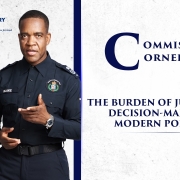
THE BURDEN OF JUDGMENT & DECISION-MAKING IN MODERN POLICING
There are professions where decisions can be revisited, revised, delayed or delegated. Policing does not enjoy that luxury. Every day, police officers are required to assess danger, interpret behaviour, evaluate risk and respond to uncertainty in real time. Those decisions often unfold within seconds. Their consequences can last for decades.
That difficult reality sits at the centre of the latest Commissioner’s Corner written by Police Commissioner Dr Kevin Blake, who this week turns his attention to one of the most consequential dimensions of law enforcement: decision-making.
The timing of the Commissioner’s reflections is significant. Jamaica has once again found itself engaged in intense public debate surrounding police use of force following a recent fatal shooting incident in St James. Dr Blake never references the matter directly. He does not litigate the specifics of any active controversy. He instead chooses a more strategic and intellectually disciplined route. He examines the broader reality within which police decisions are made.
“Policing is, by its very nature, a profession of decisions,” the Commissioner writes. “Every day, across Jamaica, we are called upon to make judgments that carry consequences for life, liberty, safety, public confidence, and national stability.”
That point establishes the gravity of the discussion immediately. Decisions in policing are rarely administrative abstractions. They carry human consequences. They affect victims, suspects, families, communities and the legitimacy of the state itself.
Importantly, the Commissioner resists the temptation to romanticise policing. He instead grounds his argument in operational realism. “Some of these decisions are made in the quiet of an office after long reflection and consultation. Others are made in fractions of seconds on a roadside, in a volatile and hostile crowd, during a domestic dispute, or in the face of imminent danger.”
That distinction matters profoundly in any serious discussion about accountability and police conduct. Public analysis of controversial incidents often occurs after the fact, under conditions of calm reflection, slowed footage, legal interpretation and emotional distance. Operational policing unfolds under entirely different conditions.
“One of the realities that we all must accept is that policing rarely affords the luxury of perfect information. We often act under pressure, uncertainty, fatigue, emotional intensity, and incomplete facts,” Dr Blake observes.
This is perhaps the most intellectually rigorous section of the Commissioner’s column because it introduces a concept often absent from public commentary: bounded rationality.
Drawing on the work of Nobel Laureate Herbert Simon, the Commissioner notes that human beings “make decisions not with perfect knowledge, but within the limits of time, information, and circumstance.”
That insight is foundational to understanding policing in democratic societies. Police officers are not omniscient actors operating with complete situational awareness. They are human beings making rapid judgments inside unstable, unpredictable and often dangerous environments.
“When we are confronting an armed suspect, a rapidly evolving confrontation, or a threat to innocent citizens, we cannot pause the moment to conduct an academic seminar on alternatives,” the Commissioner writes bluntly. “Decisions must often be immediate.”
That statement should not be interpreted as an argument against accountability. Dr Blake explicitly rejects such a position. “Accountability remains essential in democratic policing,” he states clearly.
What the Commissioner demands, however, is analytical fairness. “There is an important distinction between evaluating a decision and ignoring the conditions under which it was made,” he cautions.
That distinction is critical. It introduces nuance into a discourse that increasingly struggles to accommodate complexity. The Commissioner recognises that operational policing will always attract scrutiny. He welcomes that scrutiny within the framework of democratic accountability. Yet he also insists that public evaluation must account for operational context, human limitation and the reality of decision-making under pressure.
“Critics and commentators often have the benefit of time, distance, hindsight, multiple video angles, legal consultation, and emotional detachment,” he notes. “You who are on the ground have none of those luxuries.”
That passage may become one of the defining reflections of his tenure because it captures the widening divide between operational reality and public perception in modern policing.
The Commissioner’s response to this tension is not defensiveness. It is preparation. “It is therefore important that we continue to train rigorously, think critically, and act professionally,” he argues.
This emphasis on training and disciplined thinking reappears throughout the column. Dr Blake repeatedly returns to the importance of professionalism, emotional maturity and intellectual resilience within policing culture. The Commissioner writes, “We must learn not to become paralyzed by criticism nor intoxicated by praise. Good decision-making is not the absence of criticism; rather, it is the disciplined pursuit of what is lawful, ethical, and necessary despite criticism.”
That is a remarkably sophisticated articulation of leadership under scrutiny. The Commissioner also broadens the discussion beyond frontline encounters and into strategic leadership itself. Decisions surrounding anti-corruption measures, redeployments, disciplinary actions and modernization efforts, he argues, frequently generate resistance despite their necessity. “Leadership decisions cannot be driven solely by popularity,” he writes. “They must be guided by principle, evidence, ethics, and the greater good.”
Ultimately, this latest Commissioner’s Corner is about judgment in its deepest sense. It is about the burden carried by those entrusted with state authority. It is about recognising both the necessity of accountability and the reality of operational friction. It is about cultivating police officers who can think clearly amid uncertainty and leaders who can act decisively amid pressure.
“The nation depends on our judgment every day,” Dr Blake concludes. “Let us therefore strive to ensure that our decisions – whether operational, tactical, or strategic – are grounded in professionalism and wisdom.”
In a society increasingly shaped by instant reaction and simplified narratives, that call for wisdom may be one of the most important interventions the national conversation can receive.