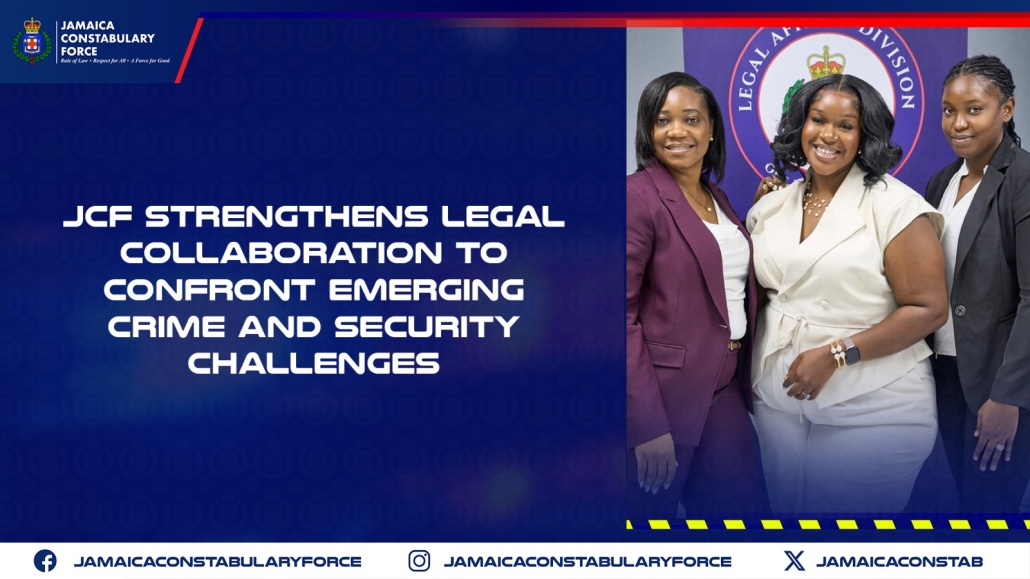
JCF STRENGTHENS LEGAL COLLABORATION TO CONFRONT EMERGING CRIME AND SECURITY CHALLENGES
As crime becomes increasingly complex, technology-driven and interconnected, the Jamaica Constabulary Force (JCF) is strengthening collaboration among legal professionals across the national security sector to enhance the country’s collective response to emerging threats.
Through its Legal Affairs Division, the JCF hosted a conference on Thursday, September 24, at the Office of the Commissioner of Police under the theme, “At the Intersection of Law and Security: A Seminar for Attorneys-at-Law Operating in the National Security Sector.”
The initiative brought together attorneys from across Jamaica’s national security architecture to deepen professional relationships, share legal expertise and examine the increasingly important intersection of law, ethics and public service in the delivery of national security.
The conference comes against the backdrop of an evolving crime environment in which cybercrime, financial fraud, virtual assets, artificial intelligence and digital evidence are presenting new and increasingly complex legal considerations for law-enforcement and national security agencies.
While agencies must continuously adapt to new technologies and criminal methodologies, they must do so within a strong legal framework that protects constitutional rights, upholds due process and maintains the integrity and admissibility of evidence.
SSP Brown-Blake, head of the JCF’s Legal Affairs Division, said the conference was developed in recognition that many of the legal challenges confronting their attorneys are interconnected.
“Attorneys-at-Law across the national security sector face many related legal issues but have limited opportunities to exchange experiences and build professional relationships. With the guidance of the Commissioner of Police and the JCF Staff Officer, the conference was therefore created to foster greater collaboration and strengthen the legal response to shared national security challenges,” SSP Brown-Blake said.
Strong legal collaboration is equally important to helping agencies navigate complex investigations, emerging technologies and evolving threats while maintaining the rule of law.
SSP Brown-Blake said this is particularly important in an environment where crime increasingly cuts across institutional and jurisdictional boundaries.
“Crime and national security challenges are increasingly complex and interconnected, requiring agencies to work more closely together. As One Force for Good and Jamaica’s leading national security law-enforcement entity, the JCF believes in leading from the front by bringing partners together. I personally believe that effective collaboration depends not only on laws and formal protocols, but also on trust, professional relationships and the ability to engage respectfully even where institutional positions differ.”
The conference therefore placed deliberate emphasis not only on legal knowledge, but also on building the professional relationships and institutional trust needed to support effective inter-agency cooperation.
Presentations were delivered by King’s Counsel Caroline Hay; Judi-Ann Edwards, Senior Attorney-at-Law and former Deputy Director of Public Prosecutions; representatives of the JCF Medical Services Branch; and ASP Romario Reid.
Participating legal officers represented the Jamaica Constabulary Force, Jamaica Defence Force, Ministry of National Security, Department of Correctional Services, Major Organised Crime and Anti-Corruption Agency, Jamaica Customs Agency, Firearm Licensing Authority, Passport, Immigration and Citizenship Agency, and Police Civilian Oversight Authority.
Sponsored by the Pan American Development Foundation (PADF), the conference also explored the particular responsibilities of attorneys operating within government and national security environments. Discussions addressed the need to balance personal convictions with organisational objectives, manage the physical and psychological demands of high-pressure environments, and maintain professionalism and courtesy even in adversarial circumstances.
Beyond the exchange of legal knowledge, the initiative is intended to help develop a stronger network of national security attorneys who can draw on shared experience and trusted professional relationships when confronting complex legal issues.
For the JCF, that collaboration is part of a broader strategic imperative: ensuring that Jamaica’s response to increasingly sophisticated crime is operationally effective, legally sound, and constitutionally grounded.