
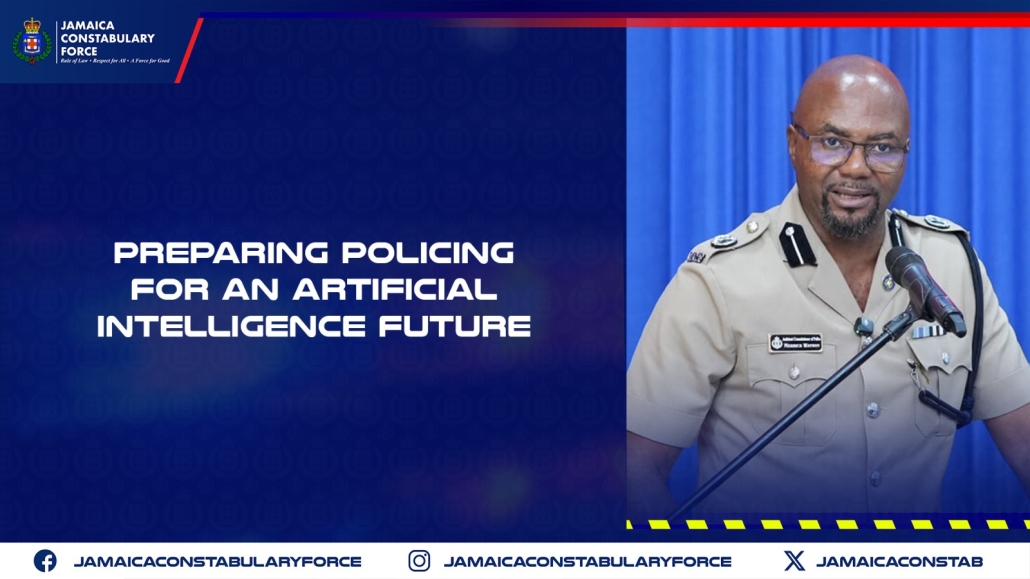
Preparing Policing for an Artificial Intelligence Future
PREPARING POLICING FOR AN ARTIFICIAL INTELLIGENCE FUTURE
Artificial Intelligence (AI) is changing the way information is created, crimes are committed and evidence is assessed, prompting the Jamaica Constabulary Force (JCF) to examine how best to harness the technology as it prepares for the evolving demands of modern policing.
The issue came into sharp focus as the National Police College of Jamaica (NPCJ) hosted an AI Conference, bringing together law-enforcement personnel, members Jamaica Defence Force (JDF) and Department of Correctional Services (DCS), educators and students to examine the opportunities and challenges presented by the rapidly evolving technology.
Held under the theme “The Values, Benefits and Pitfalls of AI in an Integrated World,” the conference explored AI’s growing application in investigations, intelligence, national security and service delivery, while also examining questions of accountability, data protection and human judgement.
In his address, Assistant Commissioner of Police (ACP) Merrick Watson said the starting point for law enforcement should not simply be what AI can do, but what it should be permitted to do and who should make that decision.
“The more powerful AI becomes, the more important human responsibility becomes,” he noted, warning that “AI does not eliminate human errors, it can industrialise it.”
Watson said accountability must remain with people, particularly when AI-generated information is inaccurate.
That emphasis on human responsibility was also echoed by guest speaker Mr. Christopher Reckord, Chairman of Jamaica’s National Artificial Intelligence Task Force, who described AI as a “force multiplier” capable of helping officers process information and work more efficiently. However, he noted that “AI is here to assist us, not to decide for us,” adding that if police officers are going to use AI in their investigations, they must be properly trained, use approved tools and follow safeguards, particularly given the volume of personal and sensitive information handled by investigators.
At the same time, AI is changing not only how law enforcement can work, but also the environment in which officers operate.
Major Basil Jarrett, Director of Corporate Communications and Client Service Excellence at Major Organised Crime & Anti-Corruption Agency (MOCA), highlighted the growing challenge of determining what information is authentic as AI fuels the spread of misinformation, deepfakes and fabricated audio-visual content.
He said this has implications for law enforcement, particularly in investigations, evidence authentication and public trust, as criminals can use AI to impersonate officials and create convincing fake reports, voices and videos.
Jarrett also pointed to the growing use of AI in fraud and social-engineering schemes, noting that technology is allowing tasks that once took weeks to be completed in minutes. That evolving threat makes another skill increasingly important, the ability to question and critically assess information, even when it appears convincing.
Professor Paul Golding, Chairman of the NPCJ Appeals Committee and former Dean of the College of Business and Management at University of Technology, Jamaica (UTech, Ja.), said critical thinking must remain central to the use of AI.
“If critical thinking is not there, how do you criticise AI?” Golding said AI should work alongside people, with human beings maintaining oversight of both the technology and the information it generates.
The conversation extended beyond the speakers, with interactive panel discussions giving students an opportunity to engage directly with questions surrounding AI and its implications for policing, academics and society in general.
The discussions provided a glimpse into an emerging reality for law enforcement: AI is not simply a technology for the future. It is already influencing the information environment, investigations and the way criminals operate.
For the security sector, preparing for that reality means equipping officers to harness the benefits of AI while retaining the proper judgement to question its output, verify information and remain accountable for the decisions that matter.