What Will Be Better Because You Were Here?
WHAT WILL BE BETTER BECAUSE YOU WERE HERE?
Every career ends. The uniform is worn for the last time, the office is cleared, and the authority that once accompanied rank passes to someone else. What remains is the effect of the person’s service: the officers developed, the standards defended, the decisions made and the condition in which the institution was left.
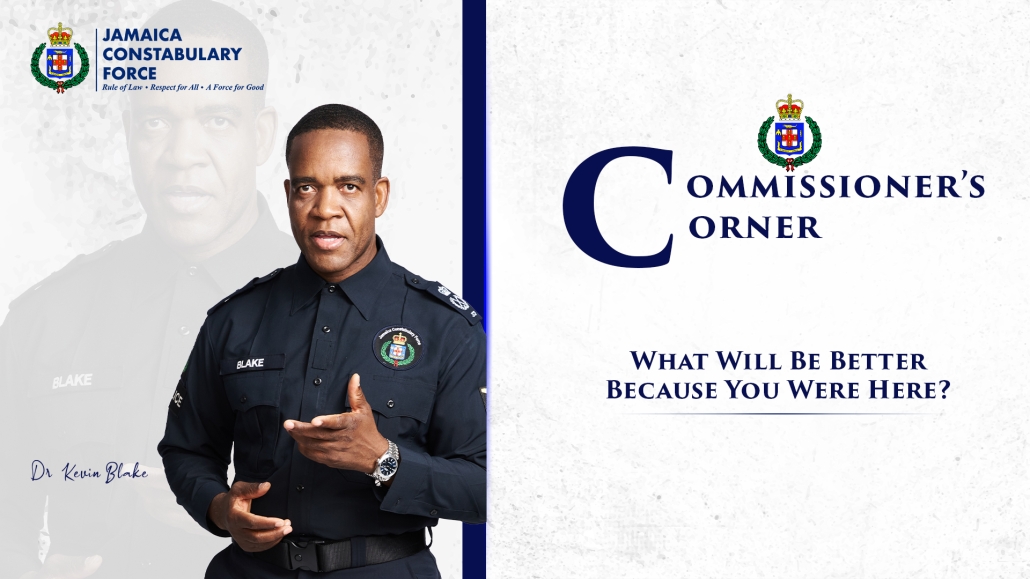
Police Commissioner Dr Kevin Blake places that reality before members of the Jamaica Constabulary Force in his latest Commissioner’s Corner. His central question is direct; “When I leave this Force, will it be better because I was here?”
It is a demanding test of professional life. Length of service can be counted. Promotions, commendations and operational successes can be recorded. Legacy is harder to measure because much of it exists in other people and in practices that continue after their originator has departed.
Dr Blake therefore locates legacy in the routine exercise of responsibility. It may be found, he writes, “in the young officer we took the time to mentor, the colleague whose confidence we helped to build, the difficult decision we made because it was the right thing to do, or the wrong we had the courage to challenge.” He adds: “Sometimes, our greatest contribution is simply the standard we refused to compromise.”
That observation carries particular weight in policing. Institutions declare their values through policies, codes and strategic plans. Members determine whether those values survive contact with daily reality. A policy on professionalism has little force if incivility is tolerated. A commitment to accountability becomes hollow when wrongdoing is ignored. A transformation programme cannot succeed where members continue to defend familiar practices simply because they are familiar.
The Commissioner makes this connection explicit: “Transformation is not something that belongs only to the Commissioner, the executive, or those who lead from the top.” It is found in what each member does “with the responsibility entrusted to us, every day, wherever we serve.”
Large organisations often speak of transformation as though it proceeds exclusively from the centre. Senior leaders announce the vision, allocate resources and establish systems. Their decisions matter greatly. Yet implementation occurs elsewhere: at station counters, on patrols, in briefing rooms, during investigations and in the supervision of junior officers. Each encounter either gives institutional policy practical meaning or exposes the distance between the organisation’s stated values and its actual conduct.
This is why individual responsibility cannot be separated from organisational change. The public experiences the JCF through particular police officers. Citizens rarely encounter a strategic plan. They encounter the constable who receives a report, the detective who provides an update, the traffic officer who exercises discretion and the supervisor who responds to a complaint. Those interactions become the public’s evidence about the institution.
Dr Blake acknowledges the Force’s progress against violent crime and the contribution of investment and stakeholder support. Those gains deserve recognition. He nevertheless cautions that “our transformation cannot be measured by crime statistics alone.”
Crime figures measure an essential part of police performance. They cannot fully measure the legitimacy with which authority is exercised. For that, the Commissioner directs attention to “how we treat people, how we exercise authority, how we make decisions, how we account for our actions, and how we conduct ourselves when nobody is watching.”
The final phrase is especially important. Conduct under observation may reveal discipline. Conduct without observation reveals whether institutional values have been internalised. An officer’s willingness to act properly when praise is unlikely and detection seems remote is one of the clearest tests of integrity.
The same principle applies to leadership. Supervisors shape organisational culture through the conduct they reward, correct or quietly permit. Junior officers learn from formal instruction, but they also study what happens around them. They notice whether poor conduct carries consequences. They learn whether honesty is protected, whether competence is recognised and whether rank provides insulation from accountability.
The Commissioner asks every supervisor: “What kind of example am I setting for those who look to me?” The answer may influence the organisation long after that supervisor has retired. A leader can reproduce the deficiencies inherited from an earlier generation, or interrupt them.
This gives mentorship an institutional purpose. Preparing another officer to lead well is part of building the future JCF. It transfers judgement, professional discipline and ethical standards across generations. The officer who has been properly guided may later make a decision affecting an investigation, a community or the reputation of the Force. The original act of mentorship continues through choices the mentor may never witness.
Responsibility also requires honest engagement with failure. “We will all make mistakes. None of us will get everything right,” Dr Blake writes. He proposes a mature standard: members should learn from error, accept accountability, act correctly when doing so is difficult and challenge wrongdoing when silence would be easier.
This conception of legacy leaves little room for passive service. Time spent in an institution does not, by itself, improve it. Rank does not guarantee influence of lasting value. A member may occupy an important position while leaving its underlying problems untouched. Another may serve without public recognition while shaping the judgement and conduct of dozens of colleagues.
“Every generation of police officers inherits an organization,” the Commissioner writes. “But every generation also has a responsibility to determine what that organization will become.”
The JCF inherited by the next generation will be the cumulative result of present choices. Its culture will carry forward what today’s members encourage, excuse, correct and defend. Transformation therefore has an intensely personal dimension. Every member is deciding, through daily conduct, what kind of institution others will inherit.
A worthwhile legacy begins with a question that should follow every rank and every assignment: What will be better because I was here?