Archive for category: News

Blake Warns Against Commentary Based on Misleading Headlines

BLAKE WARNS AGAINST COMMENTARY BASED ON MISLEADING HEADLINES


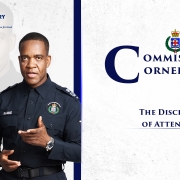
Commissioner of Police Dr Kevin Blake has urged members of the public to read articles in full before commenting on them, warning that misleading headlines and distorted interpretations can create messages that were never intended.


Writing in his latest Commissioner’s Corner column, published in the weekly Force Orders, Dr Blake said the feature was created to facilitate meaningful discussion among members of the Jamaica Constabulary Force but had increasingly become the subject of wider public commentary.


“The Corner is intended for us to have meaningful discourse among ourselves as members of the JCF. However, it has become the source of much public discourse. And we have no issue with that.”


The Commissioner said difficulties arise when commentary is based on headlines or partial accounts rather than the complete text.


“There are some spaces who make their own headlines, and skew much of what is said to create different messages,” he said.


Dr Blake advised external commentators to “avoid commenting on an article that you have not read”, adding: “Read, understand, then comment.”


He made clear that he was not objecting to criticism or public discussion of the column. The Commissioner said informed responses could provide useful perspectives for the organisation.


“If you do, we may very well benefit from good feedback and suggestions that we can use,” he said.


Dr Blake placed the issue within the wider context of social media, which he said had changed the speed and reach of public communication.


He acknowledged that digital platforms allow people to mobilise assistance, educate others, share information, expose wrongdoing and bring communities together.


However, he warned that the same platforms could be used to spread false or malicious information and manufacture controversy in pursuit of online engagement.


“There are those who have chosen to use these platforms not to inform but to misinform; not to build but to destroy; not to contribute meaningfully to public discourse but to manufacture controversy,” he said.


“Some seem to measure success by the number of likes, shares, views and followers they can accumulate, even when what they are circulating is false, malicious or deliberately misleading.”


The Commissioner also cautioned against treating popularity or wide circulation as evidence that information is accurate.


“The fact that something is circulating widely does not make it true,” he said. “The fact that someone has thousands of followers does not make them credible. And the fact that a story is sensational does not make it worthy of our attention.”


Dr Blake urged social-media users to exercise greater responsibility when publishing or circulating information.


“We should therefore exercise some maturity in what we post, what we repeat and what we share,” he said.


The Commissioner also told JCF members that they must remain receptive to legitimate criticism while refusing to become distracted by every rumour, provocative post or online controversy.


“We must see the environment in which we operate, understand the challenges we face, listen to legitimate criticism and remain alert to emerging threats and opportunities,” he said.


“But having seen all of that, we must still be able to keep our eyes on the destination.”


Dr Blake described this approach as “blinkered focus”, which he said required members to determine which issues deserved their attention while remaining guided by facts, the values of the organisation and its mission.


“Not everything that is said about us deserves a response,” he said. “Not every rumour deserves our attention. Not every social-media post deserves to become a matter of discussion in the workplace.”


He added: “Sometimes the most disciplined response is no response at all.”
Public Servants’ Private Lives Are Not Public Property — Blake


PUBLIC SERVANTS’ PRIVATE LIVES ARE NOT PUBLIC PROPERTY — BLAKE


Commissioner of Police Dr Kevin Blake says accepting the responsibilities of public service does not make every aspect of a person’s private life a matter for public consumption.


Writing in his latest Commissioner’s Corner column, published in the weekly Force Orders, Dr Blake acknowledged that police officers and other public servants must expect scrutiny of their official conduct.


“When we accept the responsibility of public service, we accept that our conduct in the execution of our duties will be subject to public scrutiny,” the Commissioner said. “That comes with the territory.”


He said the public has a legitimate interest in assessing how public servants perform their functions, exercise authority and uphold the standards required of them.


Dr Blake, however, argued that this legitimate interest does not extend automatically to every aspect of a person’s private affairs.


“Being a public servant does not mean that every aspect of your private life becomes public property,” he said.


The Commissioner described the boundary as the difference between “public accountability and public entitlement”.


“Our positions do not erase our right to a private life,” he said. “What happens within the legitimate boundaries of our personal lives is not automatically the business of strangers, social-media commentators or anyone who happens to have an opinion and an internet connection.”


Dr Blake said personal matters properly contained within an individual’s private life should remain under that person’s control.


“Our private lives belong to us, and to the friends and families with whom we choose to share them,” he said.


The Commissioner’s comments formed part of a wider discussion about the effects of social media on public discourse and the rapid circulation of information.


He acknowledged the value of digital platforms in educating the public, sharing information, mobilising assistance and exposing wrongdoing.


However, Dr Blake warned that social media could also be used to circulate false or malicious claims and manufacture controversy.


“There are those who have chosen to use these platforms not to inform but to misinform; not to build but to destroy; not to contribute meaningfully to public discourse but to manufacture controversy,” he said.


The Commissioner also cautioned that freedom of expression does not provide unlimited protection for false statements that damage another person’s reputation.


“Freedom of expression is important, but it does not give anyone an unlimited licence to make false and damaging statements about another person,” he said.


“There are legal consequences for defamatory and libellous statements because the law recognises that a person’s reputation is valuable and that when it is wrongfully damaged, the victim should have a means of seeking redress.”


Dr Blake urged social-media users to exercise greater care when creating or circulating content.


“We should therefore exercise some maturity in what we post, what we repeat and what we share,” he said.


He also warned against treating wide circulation or the size of a person’s online following as proof that information is accurate.


“The fact that something is circulating widely does not make it true.The fact that someone has thousands of followers does not make them credible.”


The Commissioner said a balance must be maintained in which public servants remain accountable for their official conduct while retaining the personal dignity and privacy afforded to other citizens.


“We must build a culture in which public servants are accountable for what they do in the discharge of their responsibilities, while still being afforded the dignity and privacy to which every human being is entitled,” Dr Blake said.


JCF Monitoring Heightened Tensions in Denham Town Following Fatal Police Shooting

Police Seek Witnesses for Court

POLICE SEEK WITNESSES FOR COURT

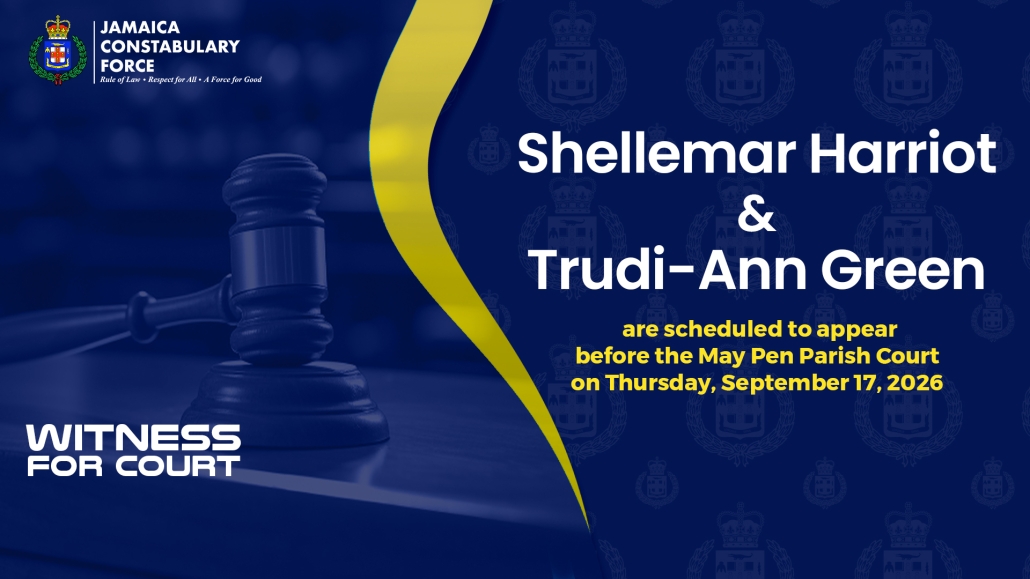
Detectives assigned to the Clarendon Criminal Investigation Branch are seeking the public’s assistance in locating two witnesses who are vital to a case currently before the May Pen Parish Court.


They are Shellemar Harriot and Trudi-Ann Green whose last known address is Riverside Park, Ensom City, Spanish Town, St Catherine.


They are scheduled to appear before the court on Thursday, September 17, 2026.


Shellemar Harriot, Trudi-Ann Green, or anyone knowing their whereabouts, is asked to contact the May Pen Police at 876-402-7265, the police emergency number at 119, or the nearest police station.

Training Helped Prevent Loss of Police Lives in St James Shooting — Blake


Training Helped Prevent Loss of Police Lives in St James Shooting — Blake

Commissioner of Police Dr Kevin Blake has credited police training with helping three officers survive a shooting in St James on Wednesday without any loss of life among the police team.

Writing in his latest Commissioner’s Corner column, published in the weekly Force Orders, Dr Blake acknowledged the dangers faced by members of the Jamaica Constabulary Force and called for prayers for the injured officers.

“On Wednesday of this week, three of our colleagues were shot and injured in St James during a confrontation with one of those hoodlums of whom I often speak,” the Commissioner said.

“Let us give thanks to God and recognise the value of training in coming out of these situations without any loss of lives on our side. Please join me in prayer for their full and speedy recovery.”

Dr Blake said police officers routinely confront situations in which their lives are placed at risk while carrying out their duties.

“Daily, you face very dangerous situations that sometimes have deadly outcomes,” he told members. “But you bravely face them, nonetheless.”

The Commissioner’s comments came as he used the column to discuss the legacy members will leave through their service to the JCF.

He said the risks associated with policing give added weight to the responsibility carried by each member and should prompt officers to consider the effect of their service on their colleagues and the wider organisation.

Crime Reduction Alone Cannot Measure JCF Transformation — Commissioner Blake


Crime Reduction Alone Cannot Measure JCF Transformation — Commissioner Blake


Commissioner of Police Dr Kevin Blake says reductions in violent crime, while important, cannot by themselves determine whether the Jamaica Constabulary Force is being successfully transformed.


Writing in his latest Commissioner’s Corner column, published in the weekly Force Orders, Dr Blake said the conduct of individual members and the manner in which they exercise police authority must also form part of any assessment of the organisation’s progress.


“Our transformation cannot be measured by crime statistics alone. The true measure of the institution we are building will also be found in how we treat people, how we exercise authority, how we make decisions, how we account for our actions, and how we conduct ourselves when nobody is watching.”


Dr Blake acknowledged the Force’s success in reducing violent crime and said this had been supported by sustained investment in the JCF and cooperation from stakeholders.


“We have demonstrated that, with the support of our stakeholders and adequate investment in the JCF, we have the resolve to confront the crime monster that has plagued our country for decades,” he said. “The progress we have made is significant, and we should be proud of it.”


The Commissioner, however, placed responsibility for the continued transformation of the JCF on members at every level of the organisation.


“Transformation is not something that belongs only to the Commissioner, the executive, or those who lead from the top. Transformation is what each of us does with the responsibility entrusted to us, every day, wherever we serve.”


Dr Blake said each generation of police officers inherits the organisation and has a duty to determine the condition in which it will be passed to those who follow.


“Every generation of police officers inherits an organisation. But every generation also has a responsibility to determine what that organisation will become,” he said.


He urged members to examine the legacy they are building through their decisions, professional conduct and influence on their colleagues.