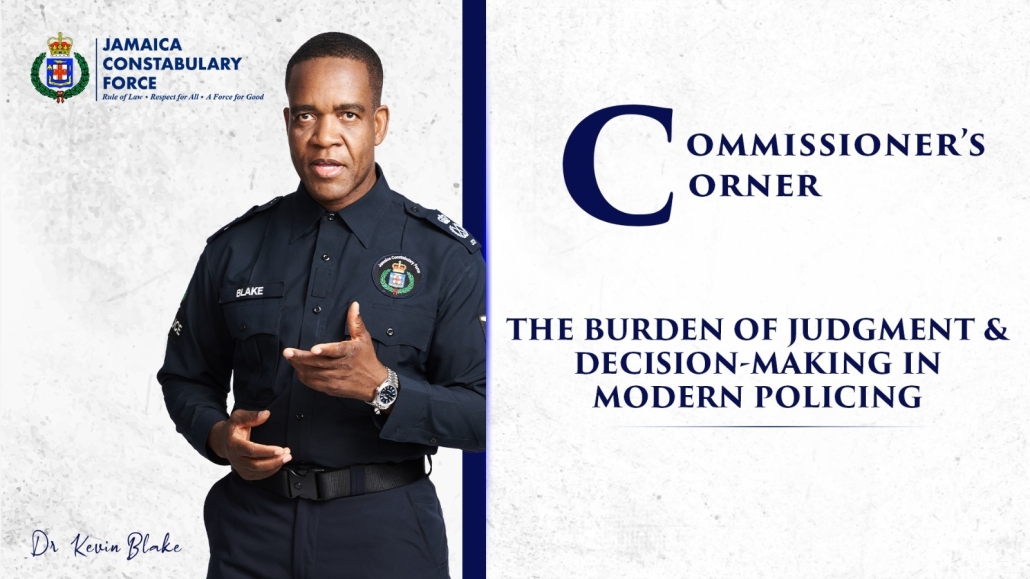
The Burden of Judgment & Decision-Making in Modern Policing
THE BURDEN OF JUDGMENT & DECISION-MAKING IN MODERN POLICING
There are professions where decisions can be revisited, revised, delayed or delegated. Policing does not enjoy that luxury. Every day, police officers are required to assess danger, interpret behaviour, evaluate risk and respond to uncertainty in real time. Those decisions often unfold within seconds. Their consequences can last for decades.
That difficult reality sits at the centre of the latest Commissioner’s Corner written by Police Commissioner Dr Kevin Blake, who this week turns his attention to one of the most consequential dimensions of law enforcement: decision-making.
The timing of the Commissioner’s reflections is significant. Jamaica has once again found itself engaged in intense public debate surrounding police use of force following a recent fatal shooting incident in St James. Dr Blake never references the matter directly. He does not litigate the specifics of any active controversy. He instead chooses a more strategic and intellectually disciplined route. He examines the broader reality within which police decisions are made.
“Policing is, by its very nature, a profession of decisions,” the Commissioner writes. “Every day, across Jamaica, we are called upon to make judgments that carry consequences for life, liberty, safety, public confidence, and national stability.”
That point establishes the gravity of the discussion immediately. Decisions in policing are rarely administrative abstractions. They carry human consequences. They affect victims, suspects, families, communities and the legitimacy of the state itself.
Importantly, the Commissioner resists the temptation to romanticise policing. He instead grounds his argument in operational realism. “Some of these decisions are made in the quiet of an office after long reflection and consultation. Others are made in fractions of seconds on a roadside, in a volatile and hostile crowd, during a domestic dispute, or in the face of imminent danger.”
That distinction matters profoundly in any serious discussion about accountability and police conduct. Public analysis of controversial incidents often occurs after the fact, under conditions of calm reflection, slowed footage, legal interpretation and emotional distance. Operational policing unfolds under entirely different conditions.
“One of the realities that we all must accept is that policing rarely affords the luxury of perfect information. We often act under pressure, uncertainty, fatigue, emotional intensity, and incomplete facts,” Dr Blake observes.
This is perhaps the most intellectually rigorous section of the Commissioner’s column because it introduces a concept often absent from public commentary: bounded rationality.
Drawing on the work of Nobel Laureate Herbert Simon, the Commissioner notes that human beings “make decisions not with perfect knowledge, but within the limits of time, information, and circumstance.”
That insight is foundational to understanding policing in democratic societies. Police officers are not omniscient actors operating with complete situational awareness. They are human beings making rapid judgments inside unstable, unpredictable and often dangerous environments.
“When we are confronting an armed suspect, a rapidly evolving confrontation, or a threat to innocent citizens, we cannot pause the moment to conduct an academic seminar on alternatives,” the Commissioner writes bluntly. “Decisions must often be immediate.”
That statement should not be interpreted as an argument against accountability. Dr Blake explicitly rejects such a position. “Accountability remains essential in democratic policing,” he states clearly.
What the Commissioner demands, however, is analytical fairness. “There is an important distinction between evaluating a decision and ignoring the conditions under which it was made,” he cautions.
That distinction is critical. It introduces nuance into a discourse that increasingly struggles to accommodate complexity. The Commissioner recognises that operational policing will always attract scrutiny. He welcomes that scrutiny within the framework of democratic accountability. Yet he also insists that public evaluation must account for operational context, human limitation and the reality of decision-making under pressure.
“Critics and commentators often have the benefit of time, distance, hindsight, multiple video angles, legal consultation, and emotional detachment,” he notes. “You who are on the ground have none of those luxuries.”
That passage may become one of the defining reflections of his tenure because it captures the widening divide between operational reality and public perception in modern policing.
The Commissioner’s response to this tension is not defensiveness. It is preparation. “It is therefore important that we continue to train rigorously, think critically, and act professionally,” he argues.
This emphasis on training and disciplined thinking reappears throughout the column. Dr Blake repeatedly returns to the importance of professionalism, emotional maturity and intellectual resilience within policing culture. The Commissioner writes, “We must learn not to become paralyzed by criticism nor intoxicated by praise. Good decision-making is not the absence of criticism; rather, it is the disciplined pursuit of what is lawful, ethical, and necessary despite criticism.”
That is a remarkably sophisticated articulation of leadership under scrutiny. The Commissioner also broadens the discussion beyond frontline encounters and into strategic leadership itself. Decisions surrounding anti-corruption measures, redeployments, disciplinary actions and modernization efforts, he argues, frequently generate resistance despite their necessity. “Leadership decisions cannot be driven solely by popularity,” he writes. “They must be guided by principle, evidence, ethics, and the greater good.”
Ultimately, this latest Commissioner’s Corner is about judgment in its deepest sense. It is about the burden carried by those entrusted with state authority. It is about recognising both the necessity of accountability and the reality of operational friction. It is about cultivating police officers who can think clearly amid uncertainty and leaders who can act decisively amid pressure.
“The nation depends on our judgment every day,” Dr Blake concludes. “Let us therefore strive to ensure that our decisions – whether operational, tactical, or strategic – are grounded in professionalism and wisdom.”
In a society increasingly shaped by instant reaction and simplified narratives, that call for wisdom may be one of the most important interventions the national conversation can receive.